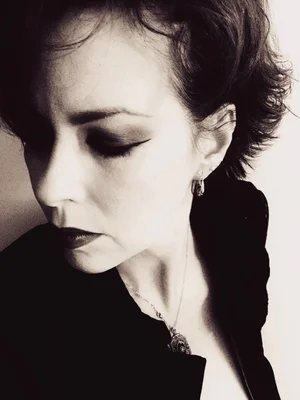
♠️ : Monday Morning 9:32am.
The coffee smells richer today. I don't know why. Maybe because I'm paying attention again. Maybe because for the first time in months my mind isn't running down the same corridor of questions, wearing thin grooves into itself. This morning I skip the cream. Black is more myself, sharper. The sugar is also enough to remind me that there is still sweetness in me, because lately that has felt uncertain.
The eggs are almost done. The sausages too. One cat is asleep on the chair beside me while the other makes her usual rounds through the house, stopping occasionally to make sure I am still where she left me. The day is really quite ordinary — calm in a way that reminds me of childhood days. That is the strange thing. The day is perfectly ordinary, and yet I am sitting here trying to explain how a person can lose so much of herself without ever leaving the room.
There was a period where I stopped drawing. It wasn't a complete stop. Just enough to scare me. People who don't make things won't understand that sentence, but artists will:
First you stop looking forward to the work. Then you stop opening the sketchbook. Next, the pencils remain where you left them. Then entire afternoons disappear. Suddenly one morning you realize weeks have gone by and you've spent them staring at a wall instead of making anything at all. That is how something important leaves a person — never in a grand collapse, but slowly, through neglect and confusion and some horrible exhaustion with a thousand tiny cuts that seem insignificant until one day you discover they have carried away something you cannot easily replace.
You've lost your blood.
I have had enough loss for one lifetime already. Loved ones disappeared into homelessness and addiction. Other family I sought for years, died before they ever really met me. My grandmother, the only person who ever loved me with the sort of certainty that makes a child feel safe in the world, is gone. Jan arrived later than I needed her to, but she became one of the most steady people I have ever known. Jon also, and most important, whose wisdom and ceaseless belief in me has made me want to be better than I am.
So when I tell you that friendship mattered to me, I am not speaking casually. I am not talking about collecting contacts or passing time online. I am talking about something that occupied the same territory as trust.
What people misunderstand is that I was never looking for a savior or a therapist. I had hoped for one honest friend. A person I didn't have to translate myself for. One person I could send a sketch to at two in the morning and say, "I think this one is finally working." Someone I could talk to without feeling like every sentence needed armor bolted onto it first. That was all.
And maybe that is why this has hurt as much as it has. Not because I lost an illusion. It hurt because I offered trust after years spent learning how dangerous trust is, and what came back to me was confusion, ambiguity, silence, and questions that nobody would answer directly. The damage wasn't a single event. It accumulated. It settled over everything. It followed me to the desk and into the work. It followed me into rooms where it had no business being.
The strange thing is that none of this began in a dramatic way. There was no thunderclap, nor catastrophe. No moment where I could say, "That was the day everything changed." It began the way many important things in my life have begun. I met somebody, and over time they became important to me.
I think people are often embarrassed to admit that now. We live in a time where every connection is treated with suspicion and attachment is lowered into some ugly explanation. But sometimes another human being enters your life and you simply enjoy them. You enjoy talking and laughing with them. You enjoy hearing what they think, and find yourself looking forward to their messages. You often are wanting to share things — a song, a poem, a photograph, a drawing you just finished, a strange thought you had while making coffee in the morning. There is nothing remarkable about this. It is one of the most ordinary experiences in the world.
What made it remarkable was how rare it had become for me.
By the time this person arrived, I had already lost so much that I had stopped expecting very much from people. The older I get, the more I realize how many relationships are built upon convenience. People drift in and out. They become busy, or disappear. They might move away, or they die. Eventually you stop expecting permanence and begin appreciating whatever time you have with someone while it exists. So when I found a friendship that felt easy, natural, and meaningful, I valued it. Maybe more than I should have.
The truth is that I trusted this person. I trusted them enough to lower my guard and speak honestly. I was comfortable enough to show them parts of myself that I normally keep protected. That may not sound extraordinary to some people, but for me it was. Trust is dangerous when you've spent most of your life learning how fragile it can be.
And then something began changing. I wish I could tell you it was obvious, or that there was a single event, a single betrayal, a single conversation that explained everything. Instead there was a growing sense that something was wrong and nobody was willing to say what it was. The friendship remained, but it no longer felt uncomplicated. Questions appeared where certainty used to be. What troubled me deeply was how things stopped fitting together in ways that started familiar — and I found myself doing what human beings always do when they care about something that suddenly stops making sense.
I tried to understand it.
What followed was not dramatic betrayals. There was no confrontation. Instead there was a slow accumulation — dates, intervals, behavior across months. Accounts that appeared and vanished. Timing too precise to be coincidental. Then the arrival of a network of activity circling something that should have been simple, operating with a consistency and coordination that eventually became impossible to explain away. I needed to trust my own eyes. I compared notes with people whose judgment I trusted. What began as uncertainty eventually became something I could no longer reasonably doubt — though I was under no illusion that I could prove it to anyone else’s satisfaction. That is the strange loneliness of knowing something you cannot fully demonstrate.
The strange thing is that certainty didn't bring relief. I had spent so long trying to understand what was happening that by the time I reached my own conclusions, I was exhausted. Somewhere along the way I realized I had been spending more energy trying to understand the activity around me, than I was in understanding myself. That cost me more than the situation itself.
My friend eventually returned. But by then something fundamental had changed in me. Explanations did not feel honest. I had spent enough time learning truth to recognize when something is off. One of the great advantages of getting older is that eventually you stop arguing with your own instincts. You may not always understand them immediately, but you learn to respect them.
When I look now at the people who spent so much time watching, circling, inserting themselves into something that did not belong to them, I no longer feel threatened. Mostly I feel puzzled. There is a level of insecurity required to organize your life around another person's attention that I simply do not understand. I had known this person only a short while before the interference began — accounts deleting themselves, reappearing under same profiles, different names — or same names, different profile. Possible accounts ran by two persons. Behavior so coordinated it could not have been accidental. And I was told it was resolved. And it was not resolved. Whatever fears were driving those actions were never my issue. I did not cause them by my actions. They belonged to somebody else. The mistake was allowing those fears to become my problem.
I am actually a very uncomplicated person. I do not enjoy competition unless it is friendly and among people I care about. I do not enjoy games unless of the intellectual kind. I do not enjoy power struggles, triangulation, jealousy, or endless psychological maneuvering. The older I get, the faster I leave situations that require those things. There was a time when I would stay and try to understand, or at least try to repair something that was never mine to deal with. That time is long since passed.
The truth is that I had to reclaim my life. Nobody was going to do it for me. So I returned to the things that have always sustained me. Visual art. Books. I filled my home with beauty. I spent time with friends. I went out when every instinct told me to stay home. For somebody as introverted as I am, that was its own act of self-preservation.
And perhaps that is the part nobody expected. Whatever the goal was — distraction, destabilization, confusion, noise — I ended up learning something about myself instead. I learned that I can survive ambiguity. I can survive disappointment. I can survive losing people I once believed would remain in my life. What I could not survive, and would not, was continuing to offer honesty to someone who had chosen not to return it. When you enter a friendship knowing you intend to harm the person inside it, you are a thief. You have stolen the truth from them. And in doing so you have surrendered your own.
Most importantly, I always knew my peace is my responsibility. Once I finally returned to my modus-operandi, everything became much simpler.
The coffee still tastes good. The cats still make their rounds. My sketchbooks are open again. I did the right thing to let go.
Self | Nov 17 | 2025