POEM: Katabasis for No One’s Benefit
Katabasis for No One’s Benefit
PART I
The woods don’t call me to tell me.
I’ve walked into their language before,
their syntax bending at the root of a sentence—
a woman ending without a period,
and the long pause of an unmapped ocean
finding its way beneath a heavy sky.
I was the argument of stones.
I’ve always been this argument of weight.
The friendship always begins in gold,
becomes a stratum—
pressed cries compacting—
mineral lies,
the earth unburying them,
and their names are given quietly
after someone who will never hear them.
I do not need to hear them.
My life, a figure at the edge of earth
who sets her wreath upon the forest floor—
not surrender, but a clean axis
of a hand that has learned the study of enough:
those elegant equations
where wanting drops to zero
and what is left is the integer of self—
irreducible, prime, cold as mercury.
She doesn’t weep. I’m of a certain class—
learned early, and kept.
I have known another woman,
one of the white interior—
not white as purity, but the silence
of a room emptied of intention,
white as the eye of something
that has never once looked inward—
and I have watched a man
mistake that blankness for depth,
confuse the echo of his wanting
for a voice that understands him,
then press his face against it
like a cartographer without direction—
a lost legend deciding blankness is territory.
Let him map her emptiness.
I am a country with a complicated border.
River systems he has never traveled,
elevations with no roads approaching,
a quality of winter light
that takes years of residency to recognize.
You cannot arrive there casually.
You cannot land there speaking loosely.
And she signaled in plain sight—
drew my attention to the old game.
I saw it, set myself between the barrels of those signals,
laid something down
to see what would return across the land:
What came back wore the face of a dog
that had taken its bite in the dark
and kept the taste of it
somewhere it wouldn’t show.
I knew it before I named it—
the taste of not quite lying
in his words and nervous laugh—
a laugh that kept something back.
A cowardice that requires upkeep—
like a garden overtaken by a small shrub
in the absence of a gardener.
And the absent gardener here is
also the delicate flower.
Now I stop.
⸻
PART II
Give the faux Phoenix that laborious landing—
the maintenance, the forgetting,
the intricate performance of narcissus—
she who has built her architecture
on the anxiety of his attention,
driving him toward the edge
the way weather drives a nail—
there he goes, a man who does not know,
his interior accepting whatever weather—
and she makes her storms for province.
This is not my sadness to carry—
but her unrest and lies acting without a stage.
No audience, no season.
My grief: I brought my full self—
compass, lamp, his coordinates—
and found the territory already deeded away
to someone with no homing,
who would not go beneath the surface
where the country actually is.
I am the depth she cannot reach
and does not know to want—
the ocean beneath her turbulence.
And what I carry down with me:
The knowledge I was a world
before a certain name spoke through me—
a territory in full before a certain man
who mistook me for scenery.
But I am the Efflorescence.
I will not mourn what could not stay its self.
I note it—
the way a scientist notes
an element that failed to bond—
then return to my woods,
the solitude that requires none,
the locked cabin of my perception
where the work is,
and the light enters
and the correct angle is found,
where silence chooses who enters.
A mountain does not grieve its own erosion.
Instead it becomes the mountain to a hill—
the hill makes it not diminished, but translated.
Something harder than the peak.
The mineral record.
The stratum that outlasts
whatever once had seen it.
Marni Fraser
April 7, 2026
6:30am
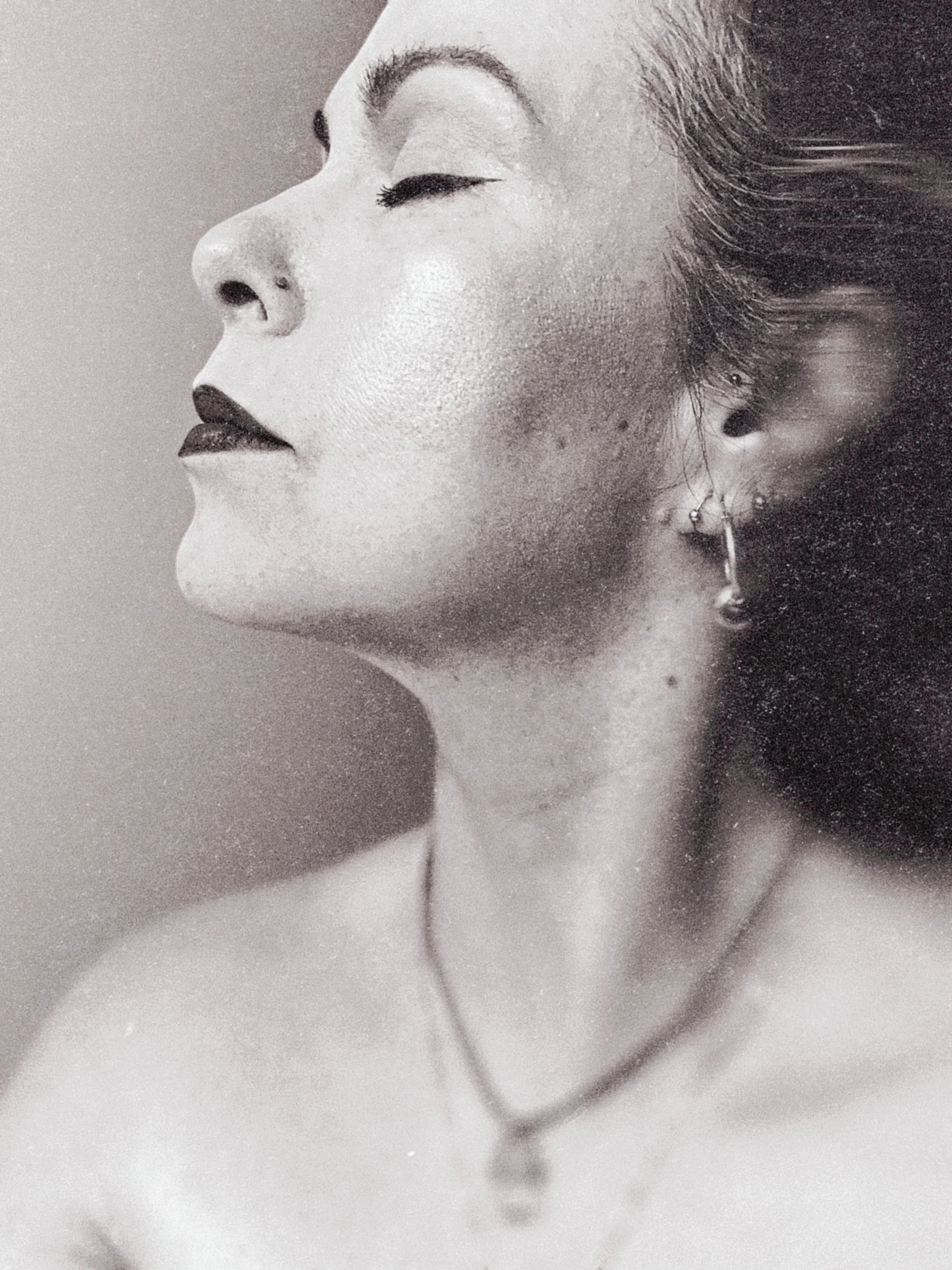
Self Portrait, January 2026