Inheritance
Somewhere in the world, two people who have been taught to distrust one another are sitting together, laughing about something entirely ordinary. Neither has thought to ask what percentage of the other’s ancestry is more important, and neither really cares.
I find something reassuring in this.
There is so much ugliness surrounding race in the world now, so much resentment being passed around as though it were normal and healthy. People speak about entire populations with a certainty they would never tolerate if the same accusations were directed at themselves. Generalizations of the worst kind are often leveled. History becomes weaponry, after ancestry is etched in stone and believed in blindly. Suddenly a person who has done nothing wrong is expected to answer for people who died centuries before they were born.
I have a serious issue with this, and I think most people should. I cannot understand what anyone believes this will accomplish insofar as harmony and peace are concerned. How can people become curious about one another under these stressful conditions?
My own family was not immune to prejudice. Growing up, I heard unkind things about the Mexican and German sides of my ancestry. Those opinions were delivered with the authority adults assume when they believe their experiences have settled a question for everyone else.
Years later, I had my DNA tested.
The results were considerably more interesting than the family narrative. Spanish, Indigenous American, German, English, Scottish, Irish, Welsh, Sephardic Jewish, African, and other ancestral connections appeared in varying proportions. Some were familiar, others unexpected. The people I heard criticized were already part of my own history, along with people nobody had thought to mention.
Imagine that.
All those years of certainty, and the evidence had been sitting quietly inside me, waiting for someone to become curious enough to want to take a look.
I did not experience this as an identity crisis. Quite the opposite. It was wonderful to discover how much I didn’t know, and how little any of it changed the person I had already become. If anything, it made me more open, compassionate, and ethical toward everybody in the world.
I have always been interested in people. Their peculiarities, intelligence, humor, kindness, and the things they make — the lives they manage to build under circumstances I may never fully understand. Their ancestry can be fascinating, but it tells me remarkably little about whether I will enjoy their company.
A person’s character requires considerably more investigation than a family tree.
I sometimes wonder what would happen if genetic testing became freely available to everyone who wanted it, accompanied by enough historical education to make the results intelligible. There would undoubtedly be surprises, perhaps a few uncomfortable family conversations, and a great many cherished assumptions requiring revision.
I personally like to daydream that everybody becomes more loving.
Of course, the information could be abused. Human beings have demonstrated an extraordinary talent for turning knowledge into an instrument of control and hate. Genetic privacy matters, and nobody should be compelled to surrender it.
Still, I like the possibility of people discovering something unexpected about themselves.
It isn’t that everyone must possess a particular mixture of ancestry to deserve respect. That would merely replace one ridiculous qualification with another. A person whose ancestors lived in the same region for generations is no less human than someone whose family history crosses six continents.
What interests me is the collapse of unwarranted certainty and the overgeneralizations that come with it.
There is an enormous difference between knowing where we came from and believing that knowledge tells us what other people are worth.
History deserves serious attention: conquest, enslavement, persecution, displacement, and the destruction of communities were real. Their consequences did not conveniently disappear when the people responsible died. Understanding these events is necessary, and where injustice continues, there is work to be done.
But I reject the suggestion that hatred becomes respectable when it is inherited from someone who suffered. And I’m seeing a lot of that lately. People must be careful not to let their fear of unfamiliar cultures, often learned through prejudice at home, determine how they treat others. They should be completely fair with one another, even erring on the side of love.
I don’t believe every disagreement about history is evidence of malice. People can examine the same events and arrive at different conclusions without becoming enemies. We should be capable of discussing difficult truths without reducing the living to representatives of the dead.
Perhaps I am particularly weary of the appetite for accusation. There is always another population to condemn, another historical grievance to enlist, another stranger whose appearance supposedly tells us everything necessary about his intentions.
It must be exhausting to live that way.
The world is already difficult enough without demanding that people carry the accumulated hostility of generations they never knew.
And yet, beyond the arguments, I see reasons to be hopeful.
Friendships continue to form across cultures. Families grow through marriages and relationships that would once have been forbidden or condemned. People learn one another’s languages, share meals, exchange ideas, make art, fall in love, and raise children whose existence quietly contradicts the old insistence that humanity must remain divided.
None of this means prejudice has disappeared. I have no evidence that everyone is becoming kinder, and I would be foolish to pretend otherwise. But the loudest expressions of hostility do not account for every human encounter taking place beyond our screens.
There are millions of ordinary kindnesses that will never become news.
I think about the extraordinary accident of being alive at the same time as so many people whose histories are entirely different from mine. How much there is to learn from them, how many friendships might never happen if I allowed somebody else’s fear to determine whom I approached.
What a terrible waste that would be.
Our differences are not the problem. I would hate to live in a world where every culture, language, tradition, and individual temperament had been flattened into something conveniently uniform. Human variety is one of the great pleasures of being here.
The trouble starts when difference is assigned a rank, or ancestry becomes a substitute for judgment — worse, when belonging to one group requires contempt for another.
I would rather inherit the music and stories, try the recipes, view art, and absorb whatever wisdom my ancestors managed to acquire. Their prejudices can remain in the century that produced them. It is the worst thing to observe in others, and I wouldn’t want it in me.
We are allowed to reject some ideologies of our ancestors.
There is something almost comical about the amount of effort human beings have devoted to proving themselves separate, while spending thousands of years crossing one another’s borders, falling into one another’s arms, and producing children who belong to histories nobody could have kept apart.
Life has been considerably less interested in our categories than we have.
Perhaps the future will be kinder to its past. I don’t know. There are days when the evidence seems discouraging, and others when the simple decency of strangers restores something inside my heart that I thought had been lost.
I am unwilling to surrender that possibility, or the hope of it.
The people who come after us deserve more than an inventory of old enemies. They deserve the freedom to meet one another without first consulting the grievances of their ancestors. They also deserve to understand history without being imprisoned by it, and to discover for themselves whom they love and trust.
We have inherited enough sorrow.
There is no reason to make hatred part of the future.
Marni Fraser
XII:III PM
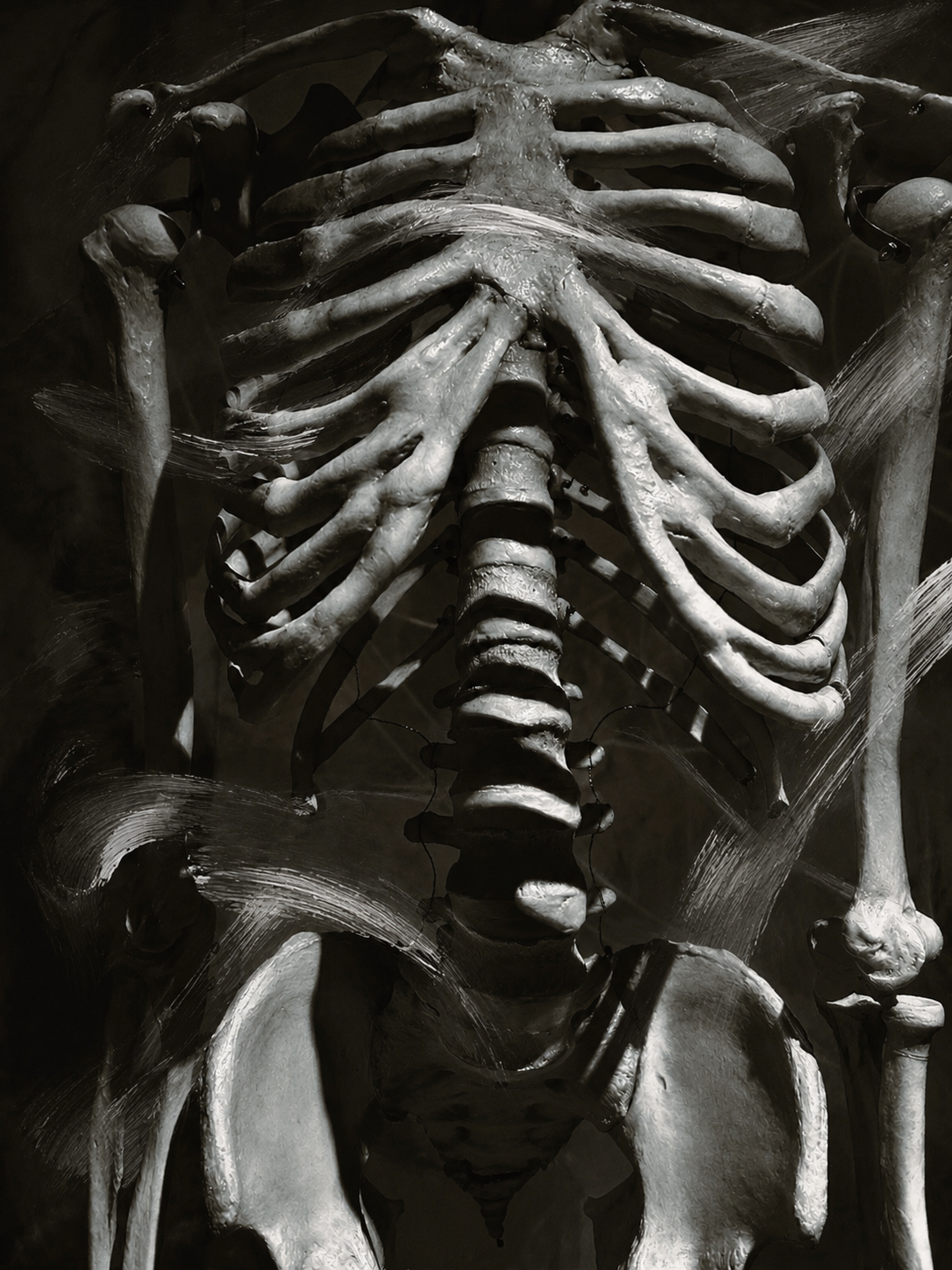
The Painted Lady | Canon EOS | [Hand-Painted Oil Overlay] | 2026 | Real Bodies