The Dying
Death
Death, why do you come and go,
teasing the blood of an imploring soul?
Why do you linger beneath my window
like a black cloak in the autumn rain,
your pale eyes full of centuries and sins,
your mouth sweet with the last roses of September?
You came in October. I was young,
when the clocks still donned their golden faces,
and the earth was round with possibility—
every flower believed itself eternal.
You didn’t take my innocence at once.
You gathered it slowly,
petal by petal,
as the wind undressed a dying day,
and a raven carried the bright fragments
of an orphaned dawn
into the mouth of the woods.
Even then, I still dreamed—
until you entered the garden
of my sleep
and buried its small, luminous animals
beneath the roots of your winter.
Even then, you left me hope.
Like a white sun tethered to a field of thorns,
like a candle burning in an abandoned shrine,
like the last red apple
clinging to a blackened tree.
And I grew—
a moon swollen with the tides of other lives,
a garden with room enough
for every wounded and wild creature.
But before the clock divided my life in two,
you came again.
You arrived a native to my anatomy—
and hope fell soundlessly,
like a magpie’s feather
upon the first frost.
Now you wander through my imagination,
your fingers stained with the pollen of dead flowers.
You trouble my compassion.
My empathy.
You whisper that goodness is a mask
worn by the hungry,
that tenderness is a fruit
concealing the worm inside its heart.
And I have grown so still
the ivy thinks I am a statue.
I am merely waiting for you now.
There is nothing I can be bothered with.
There is nothing I can hold.
There is nothing.
And yet—
here I stand,
with my ridiculous heart,
and my impossible devotion to the living.
I am the Magician,
my sorrow a thousand small suns.
I am the Hermit,
with one lantern
through a forest of extinguished stars.
And you, Death—
you are my Death.
The bruised gold of October.
A black goat standing motionless
among the graves of summer.
The raven’s throat,
black with the songs it will never sing.
And the gardens—
always heavy with desire
before the first frost.
Flowers open their mouths wider,
the earth grows fragrant with surrender.
The last bee staggers drunk
through the swollen hearts of dahlias.
Everything becomes unbearably beautiful
when it can no longer remain.
I know this.
I have walked beside you
through every season of my becoming.
And when the final roses bow,
when the magpies abandon the orchard,
when the clocks forget their hunger,
I will not mistake you for a king:
I lead you.
Marni Fraser
1027.2026
III:XXXV

Img| 2026
A Poem…
Everything Beneath the Sun
At dawn, the dragon stirs
beneath the earth's thin crust,
but breathes a fading fire.
The sun has mastered
entering quietly,
as though apologizing
for its bright days.
There are mornings
the light must be talked into the day.
And each morning,
a little less of him returns.
I wonder if he still longs
for the green inviting of spring,
or summer's endless asking,
or if he loves autumn most,
when the shadows grow long enough
to cover him,
and he need not see
his own sorrow.
I think I understand the sun.
And all the things beneath it.
Marni Fraser
10.2026
1990’s
When Giving Up
Perhaps it began with those who turned an ear
away from the wind’s carrying of my calling—
each syllable dispersed like seeds
over ground that had no germination.
Wild
It is true.
There is a quiet where my language spoke.
Perhaps it began with those who turned an ear
away from the wind’s carrying of my calling—
each syllable dispersed like seeds
over ground that had no germination.
Now even the cicadas have abandoned
their complicated machinery of sadness.
I have been the tree
beneath which men sharpened their cruelty,
confusing the intricacy of my roots
as an invitation to excavate.
I have been the bitch
whose teeth they counted
while discussing the virtue of obedience.
And what of the incessant manufacturing of meaning—
the mind pleasuring itself
against the indifferent make of the world?
There is only so much a living thing can give up
before its own heart becomes an extraction site.
Even the rhizome,
that clandestine world beneath the earth,
cannot distribute what has been exhausted.
It is true.
I’ve begun the silent work of withdrawing
from the judgment and other people’s hunger.
No surrender.
No forgiveness.
Much more primitive.
I am taking my silence with me,
—a way, certain creatures carry their venom
without ever announcing its existence.
And when anyone comes to inventory what remains,
there will be no evidence of departure—
only earth,
—disturbed where something living
escaped being domesticated.
Wild.
Marni Fraser
10|21|2026
Img|2026
The Hours, Days, Years
The Hour Between
At half past four in the afternoon,
I begin to drink.
By five twenty-eight,
I am no longer here.
There is only your face—
then only the suffering
I imagine behind your eyes,
and the terrible tenderness
of being unable to touch it.
I remember how much I love you.
How love did not end
when there was nowhere left
for it to go.
It became something
I carry.
Sometimes, I reach across the silence
to ask if you are okay,
knowing that even kindness
may feel like another wound.
Knowing you may hate me
for remembering you at all.
And here,
in this life I’ve made,
I cannot find
a single person
who believes me worth
the trouble of loving.
There are afternoons
when I’m already dead,
as though this heart
has forgotten its purpose
and continues beating
out of habit.
And still, I remember.
I remember remembering
the one time we held each other,
the way our mouths met
in a world that had already decided
we could never belong to each other.
How strange,
to have been so close
to something impossible.
But before all that,
there was Sweden—
The bed I lay in,
not knowing
which country held you.
Then you came to me
as though from a dream:
There was a dune.
A long, pale stretch of sand.
The silence of a world
I had never entered—
And you stood there,
watching.
You didn’t speak.
You didn’t come closer.
You stood against the distance,
as though you had always known
that one day I would remember.
And now the afternoon is gone.
The glass is empty.
The light has left the room.
Somewhere in the world,
you are alive.
And I am here,
alone with the memory
of having once been yours.
Marni Fraser
October 9, 2026
Real Bodies | 2026
The Forgiving Night
Marni Fraser
10.09.2026
IV:00 A.M.
Unshriven
At last my hands are free of all but this;
I court the listless hours
and call it love.
The oath I took outlives the mouth that swore;
I keep its vesper flame
against the wind.
The hills lie mute before the morning breaks;
some lambent bruise of red
unseals the dark.
At noon I sin against the blank again;
I raise unshriven hands
and wake the flesh.
No mortal love has asked of me so much;
it breaks me into form.
O art, my sin.
Marni Fraser
10.09.2026
IV:00 A.M.
Img | 2026
Food…
The Banana Who Did
Now look what I found
at the end of the summer,
in back of the fruit bowl,
grown steadily glummer.
Too bad it lacked feet,
for with feet it could run
and not be a thing
I would eat just for fun.
Perhaps, had I bitten,
it would never have died
of such terrible fright—
but it chose, then, to hide
from the spoon and the bowl,
from the cereal too,
from a breakfast at noon.
When it heard me come through,
it imagined me chew,
and it thought with a grin,
She will never find me—
which was technically true.
For weeks it lay still
and it made not a peep,
so afraid that my fingers
would peel it asleep.
It refused to be breakfast.
It refused to be pie.
It refused so completely
it forgot not to die.
By August it had
a most terrible plan:
"I'll be so un-banana
she won't know what I am."
So it sucked in its belly
and went leathery, thin,
and folded its yellow
and kept the sweet in.
And there it remained,
the brave little fool,
still hiding from hunger
behind the fruit bowl—
until . . .
I found what was left
of its devious scheme:
a banana so frightened
it had softened to cream.
Marni Fraser
09.2026
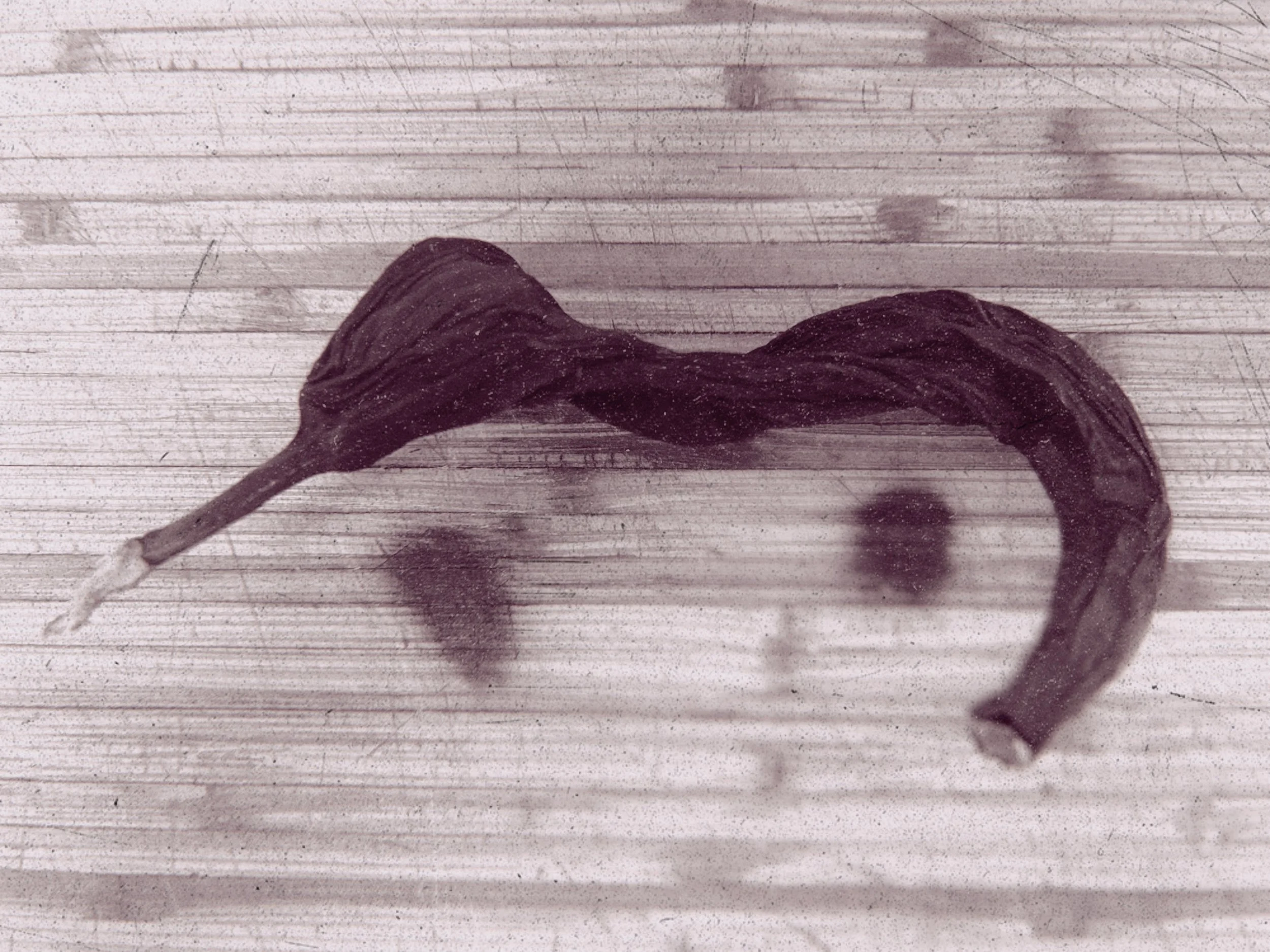
The Banana Who Did | 2026
Endings
The Promise
Soon, the black and green tide—
lilacs laid across white marble,
first breath’s bloom,
and the last exhale's fading hues.
Soon, the tired and naked copses—
children of November asleep
in wood-lined cradles,
beneath plaques inscribed
with celebration’s cold grammar.
Their skin sings into dust.
Once mated to linen,
once the beloved
on a morgue’s quiet table,
now only the echo—
like a bell’s final toll
at dusk.
This is the promise:
hesitant,
half-whispered,
never rescinded.
Marni Fraser
0101.2010
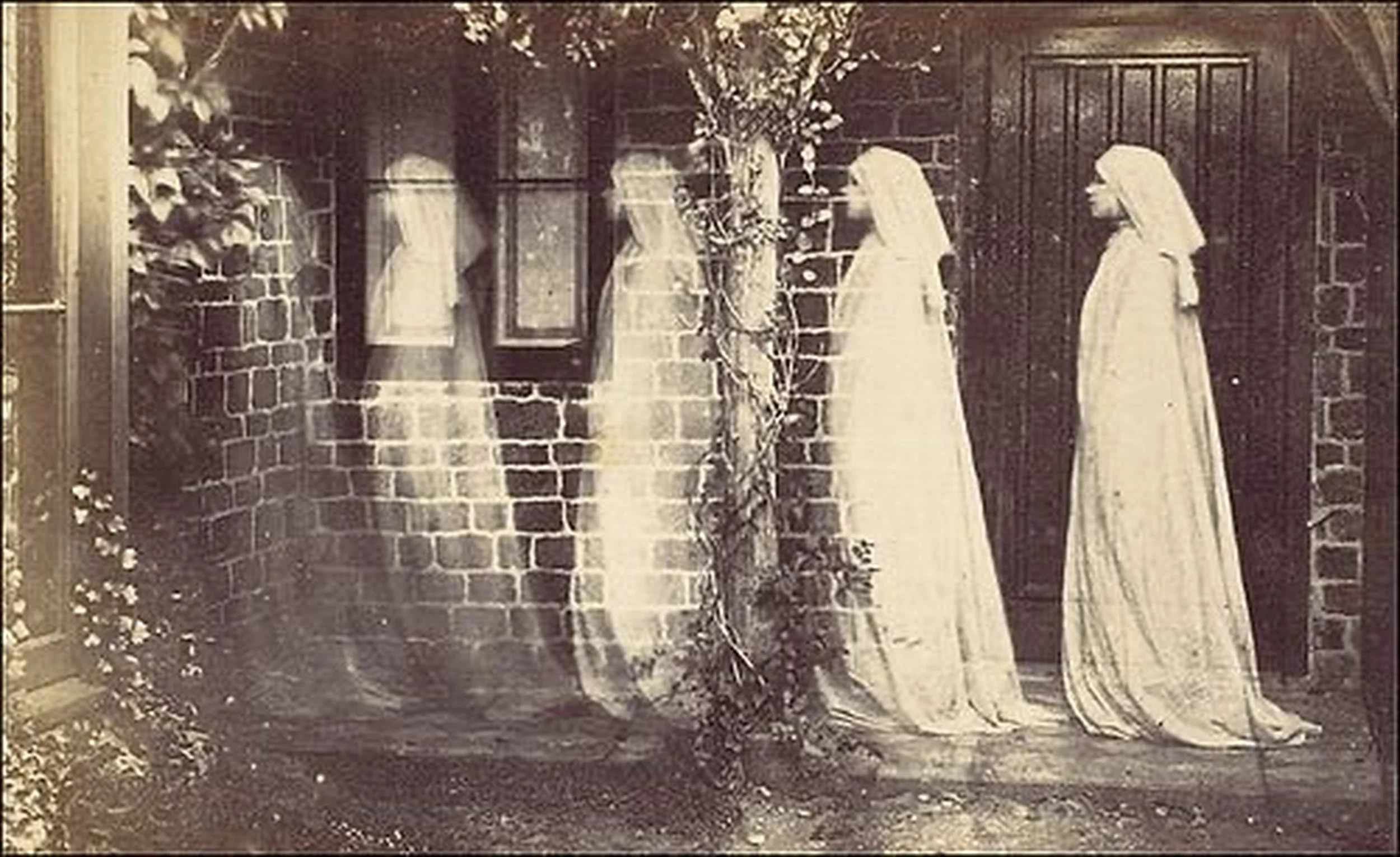
Unknown photographer, The Ghost of Bernadette Soubirous, c. 1890. Multiple-exposure photograph.
To Run
The Hedges
To sit among the hedges
she wonders toward
the other side of it—
Are there happy plates and cups?
Are the utensils
properly placed?
To run among the hedges,
she wonders along the length of it—
What causes the sudden change
from green
to the tarnish of spoons?
The eye turns downward.
First it turned away,
then turned itself inward.
Now it closes.
The happy days were there—
a pale cup-ring
drying into the table.
Gladly admitting
they hardly existed
is the weight finally falling.
I long to go.
To marry myself to death,
not its dead,
and to finally be ended
of this boring cycle.
No ode or its idea
is without it.
Marni Fraser
0928.2026
V:XVI PM
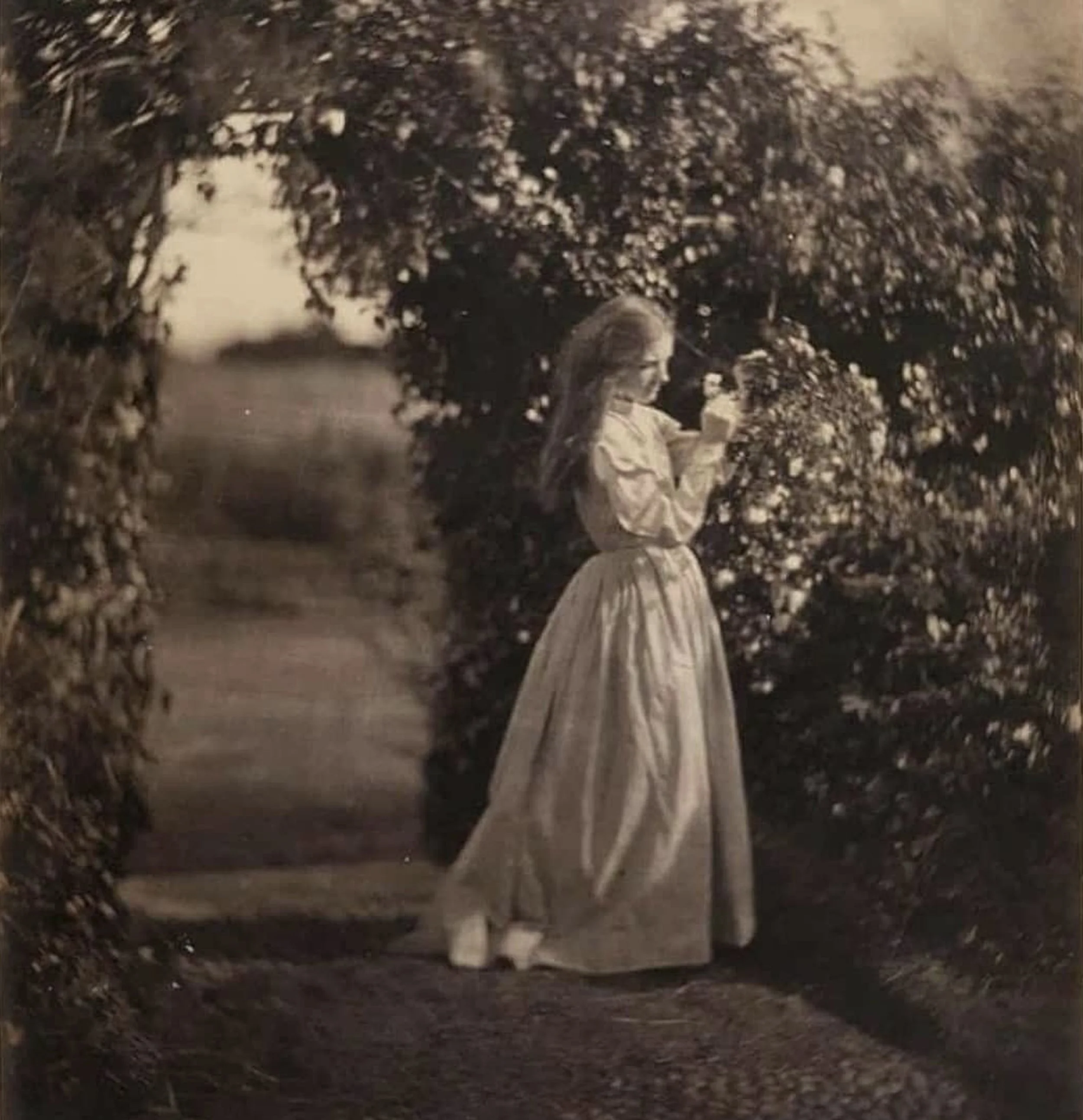
Julia Margaret Cameron, The Gardener’s Daughter, 1867. Mary Ryan, model. Albumen print.
The Bone Orchard
This autumn, the leaves
remember blood for me,
their bruised colors deepen
before staining the earth,
and they fall already wounded,
crumpled into clots,
drying where shadows form,
as though death watches.
Here, a thing beyond autumn
is altered inside me—
a small black wind
whirring under the bones,
as I remain strangely alive
after so many deaths,
wearing my pulse lightly—
In the season:
Blueberries, darkening moons.
Black cherries split open,
their mouths full of night.
And wood fractures in chimneys,
exhaling old ghosts
into the roofless eve.
There is still shelter—
a small animal’s warmth,
one lamp, a window,
and beyond the glass,
the world’s cold crown
moving in silence.
How long among crowds
did I practice vanishing,
while begging to hear
and fearing to be heard?
How long I longed
until longing grew teeth,
and its silence wore me.
Then I found it—
my face beneath faces,
my mask without pity,
the one that survived.
There is so much
the night returned.
So much carried
before knowing its name.
So much buried—
that still knew me.
Marni Fraser
0925.2026
VI:XXXVII PM
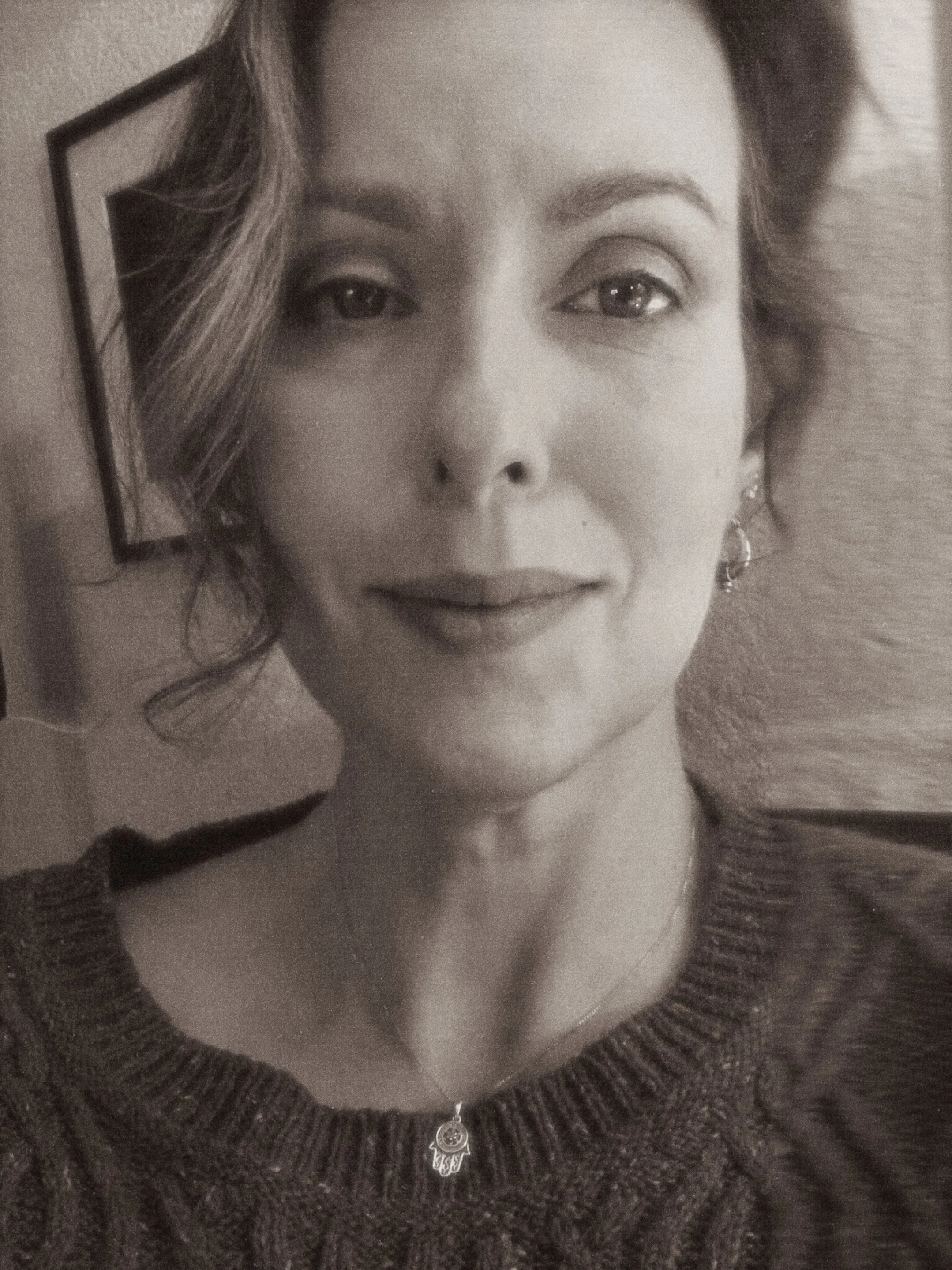
[2025]
Changed
Waving Goodbye
I stand where the earth swells
with hemorrhaging flowers—
fat with faces,
mouths opening and closing
in praise or protest
of the sun.
They are beautiful
in the way dying things are—
full of light
and already leaving.
The buildings around me
make me small.
They rise and vanish
into clouds,
but it's the trees
that feel more ominous—
the way they lean,
the shadows they cast,
how they don't need
to be anything
but alive
and older than me.
And in the stillness,
I realize
how alone I seem—
and for a moment,
I am.
I carry my love for you
like an injured thing,
dragging it by the leg
through the day.
Its neck won't hold
its head anymore.
It should be buried.
Let it sleep.
I can't read your epistles—
your poems,
your cleverness—
they no longer
speak your character.
They mouth meaning
but have forgotten
what it means.
On the way home
I pass children
shouting their needs
into the world—
unapologetic,
unworried
about sounding like themselves.
And the city cleaner—
he bows his head
to discarded things
as if they matter.
Maybe they do.
Maybe I could too.
But I'd have to give up
fortune-telling,
give up hope,
give up being
the future's echo.
I'd have to stop
apologizing
for my existence,
stop defending
my personality
like a woman
left on a desolate tract
with only her name
and a flint.
And worst of all—
I'd have to stop saying,
"So sorry.
It's my fault again."
Then maybe,
we'd become
two quiet activists—
no longer fighting
the clumsy conduct
of each other.
But today—
the plainer eye sees.
My body knows
what home means:
a place to hang the coat,
to place the hat on the hook,
to leave the sun
and step into the quiet,
closer
to the dark
where the end waits
naked-handed.
She waves.
And I,
still visible,
wave back.
Marni Fraser
0917.2012
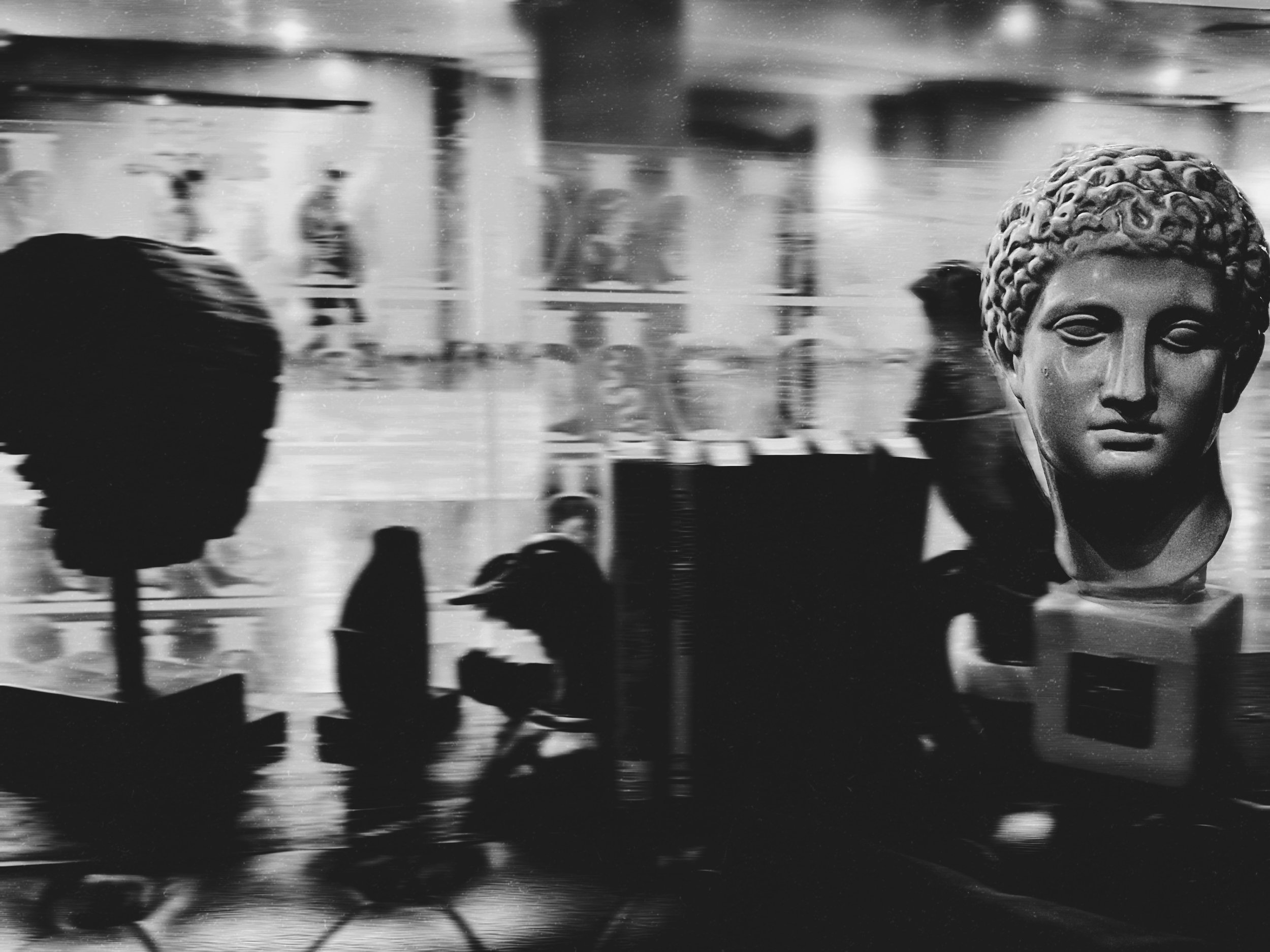
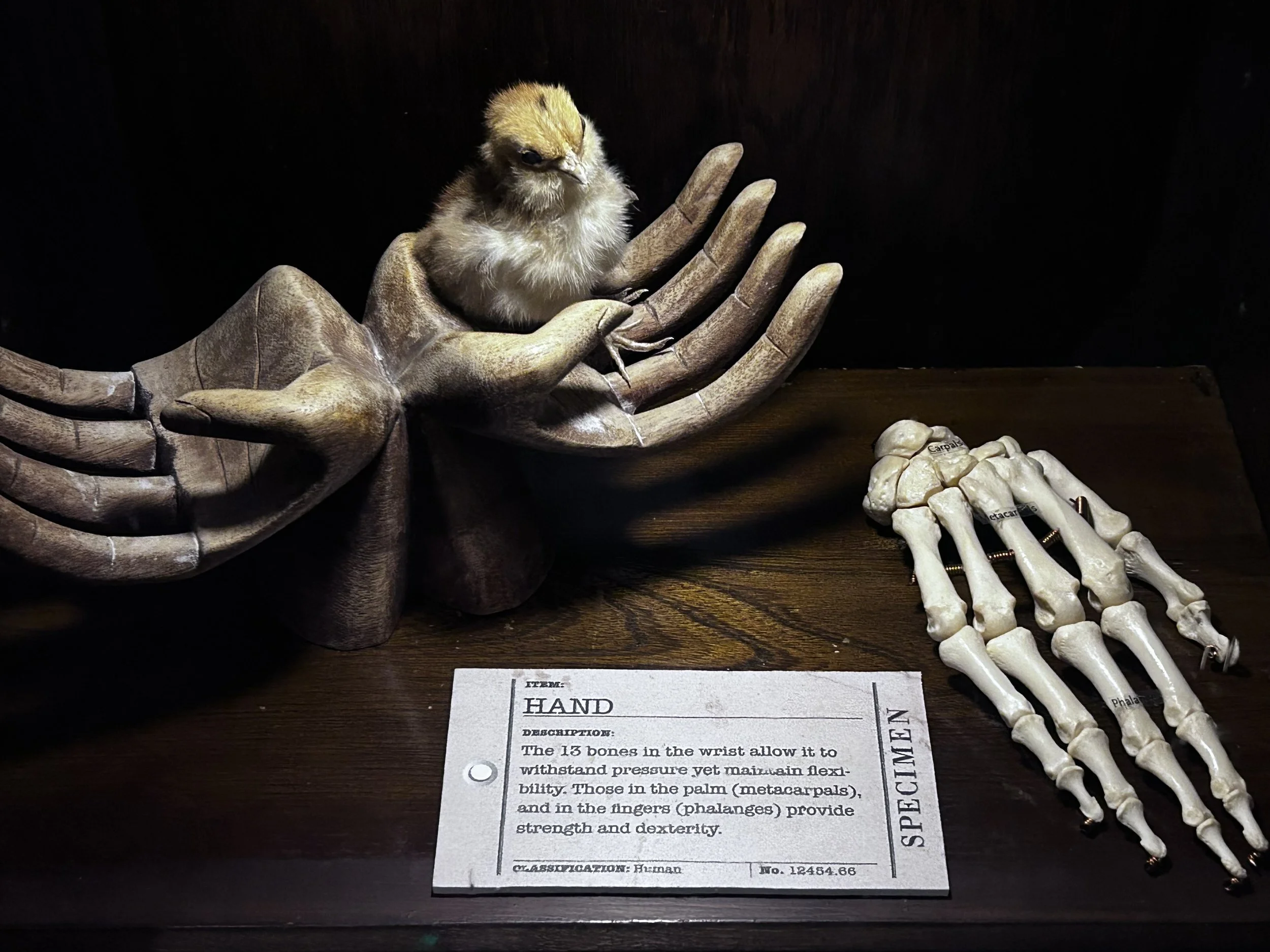
Image, “The Cabinet of Curiosities Lounge”
Las Vegas | 2026
The Sunny Days
The Unwitnessed Flower (Part II)
The flower awakens before her witnesses,
and turning her tiny face up toward the sun,
his warmth arrives without needing her beauty;
she meets his bright cheek with her open mouth,
then wears the morning’s dress simply for herself.
The insects come and praise what they see,
oh how drunk on the short-lived velvet of her.
She likes their little hymns and lets them hover,
but praise is just sunshine with a tongue;
it stays awhile, then goes off somewhere else.
Her roots have other loyalties below,
to earth accepting what no wing can love,
and rain entering every pore without judgment,
and the earth holding fast as petals lose their time;
nothing under her asking for a thing.
At dusk the moon passes the sun
while laying her body across the garden.
She keeps the flower feminine and fair,
covers her softly through the cooler hours,
and asks for nothing of the flower in return.
The insects may come back. She often notices they do.
Their praise is sweet, their company brief,
and neither makes a promise of forever.
A wing and root were never built alike;
she finally knows it without bitterness.
Her life belongs to things that know of return:
the rain, the dirt, the moon, and her faithful sun.
She turns her face toward what has always fed her,
beautiful, and unwitnessed.
Marni Fraser
0905.2026
XI:LI A.M.
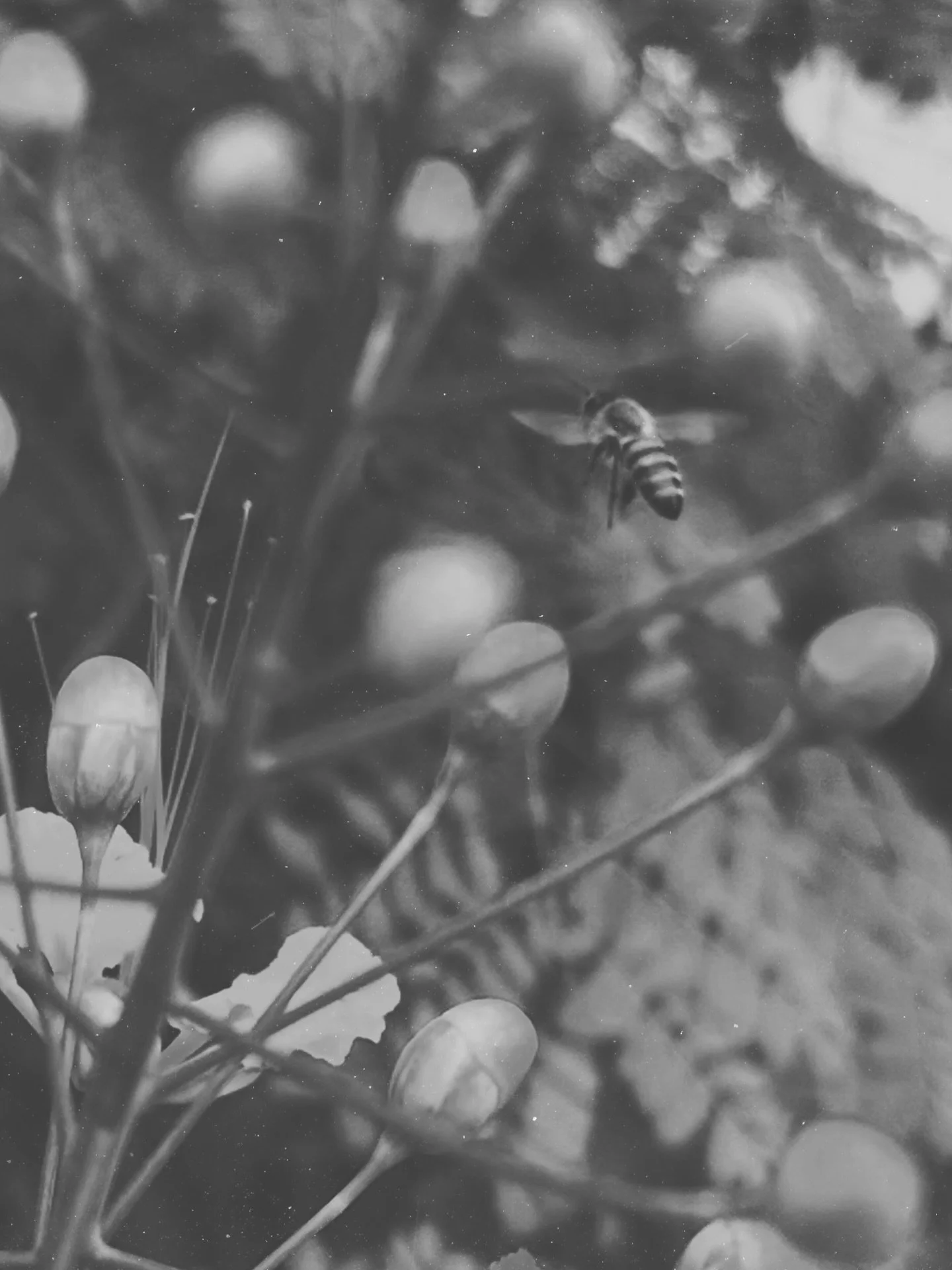
IMG|09.2026
Nature
Men Are Insects. Women Are Flowers. (Part I)
Men are insects. Women are flowers.
At dawn the garden starts its little trade;
black bodies dance through chalices for sugar,
and stems turn their faces to be chosen,
(ahhh desire, an evidence of worth.)
Nobody sees the labor underneath.
A root blind from wrestling with stone;
the stem performing its posture for the daylight,
each petal keeping ruin at its edges.
Beauty, so exhausting when it’s compulsory.
Women learn early what the garden needs:
stay lovely and somebody will bring water.
Stand straight enough, and hands will clear the weeds.
She blooms believing believing attraction is care,
until the first brown gathers at her hem.
The insect has the luxury of leaving.
His wings make hunger eat the freedom;
meanwhile, her ankles vanish into the earth
while carries yellow signs elsewhere,
still fed by what he flew from.
Sooner or later every flower bends.
Heat worries through the velvet of her face;
one loosened petal buckles from its bind.
The garden turns its bright eyes elsewhere,
although her roots are ever so ravenous.
We praise the flower standing alone,
call her strong when nobody brings light.
Somewhere beneath the praise, she thirsts.
No living thing was made to earn its tending,
nor beauty meant to function as a ransom.
Beneath us, roots are kissing in the dark.
The bee goes hungry when the flowers vanish.
Dear garden dying in pieces, somehow singly.
Whatever tenderness failed to give
returns eventually as barren ground.
Marni Fraser
0903.2026
XII P.M.
Marni Fraser
0903.2026
XII P.M.
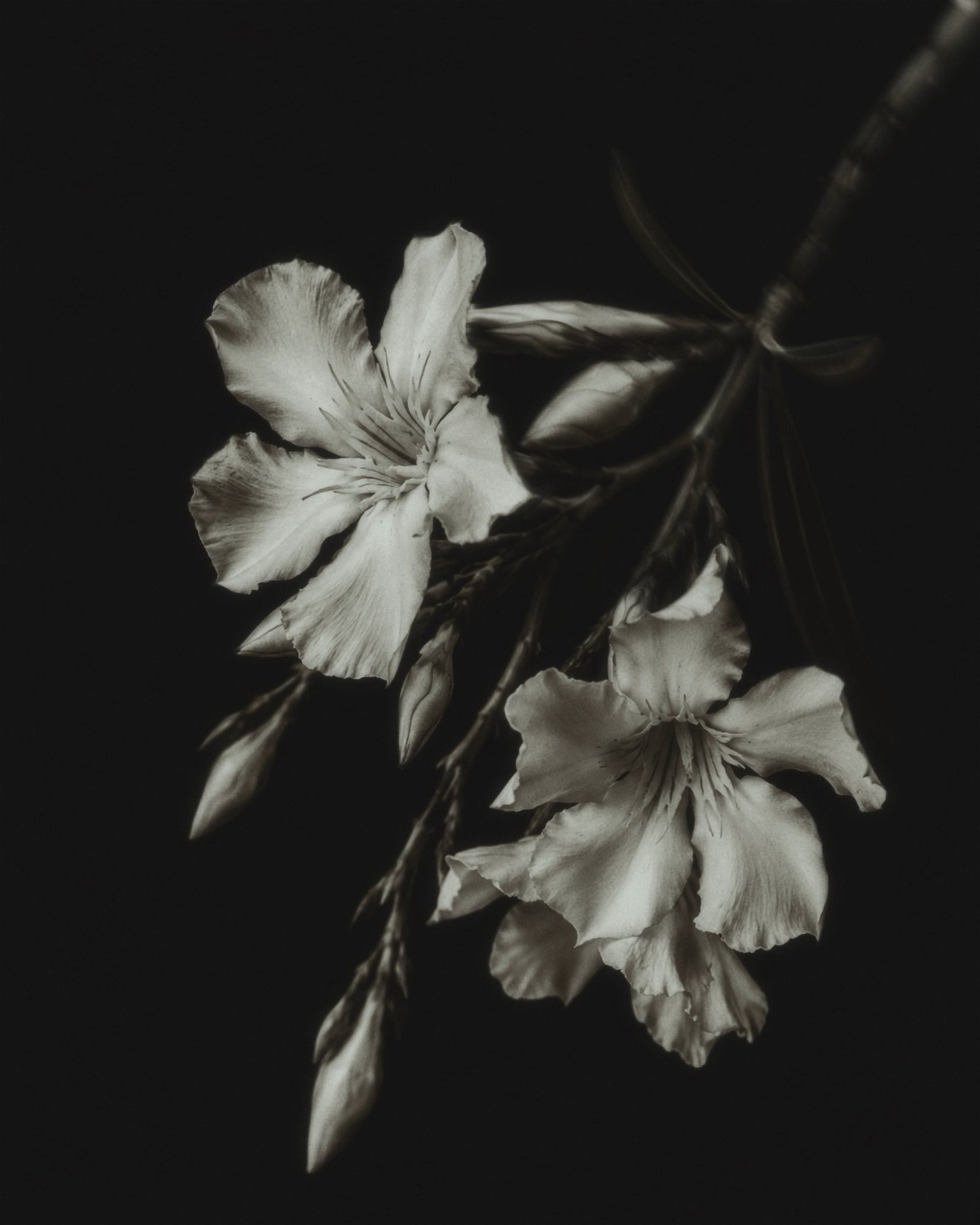
IMG|09.2026
A Clean Margin
My Knife Arrives
My knife arrives holding hands with the sun—
Soon after, I awoke,
then took the knife of my life and listened to the slice.
Hear the small slice I had been refusing to hear for years?
I executed: enough.
Enough of the half-truths,
and of the missing truth.
Enough of it arriving barefoot,
then three days late to boot,
and with blood on its feet.
I executed: enough.
You dishonest home to someone.
You've made rooms inside rooms inside rooms and called it a life.
Now standing in the wreckage,
you complain about the dust.
My heart's gone rusty loving you.
My hands mourned your beauty—
they're rusty too.
Do you understand?
Rusty.
My eyes rained for years.
Years.
They've become rusty, too.
And still, some hope sparks like a little light
through a house you kept dark.
I covered the flame.
You struck another match.
I covered the flame.
You struck another match again.
I covered the flame.
You watched.
I will never forget you watched.
And you watched.
And watched.
There are monsters who roar.
There are monsters replying politely.
There are monsters closing the door softly.
There are monsters sleeping beautifully.
And there are monsters waking without blood beneath their claws.
You were always so clean.
Or was everyone around you in the faith of looking away?
Look away.
Looking away.
And looking away, yet again.
And you—at the center of it—hungry,
always somehow starving.
But my heart remembers her rug,
her beautiful book of poems,
and every beautiful object
that might have existed between us.
Only they didn't.
Objects are innocent.
Poems are innocent.
Even memory:
it all eventually arranges itself honestly.
My brown-eyed boy was never there.
I made him up because the truth
of life's loneliness was too ugly.
So I gave you his beautiful eyes,
and in them my tenderness,
and out of your mouth my excuses.
I gave a monster years.
Years.
Years.
And years.
And sometime last night,
in night's dark,
I took them back.
Today at dawn you died inside me.
No funeral. No flowers.
No black dress.
No identifying your body.
There was only a silence,
and that I could breathe.
At last.
At last.
At fucking last.
I could breathe.
And somewhere inside me
the sun returned.
It might have been waiting
behind a locked door.
Imagine that—
or was only you in front of the light?
You, the extraction.
This removal.
This clean margin around the death.
Finally, I understand:
losing is the body rejecting poison.
It is the house throwing open its windows.
It is the knife washed clean.
It is the truth entering without knocking.
And the truth says:
At last.
At last.
At fucking last—
I am free.
Marni Fraser
0909.2026
VI:XL AM
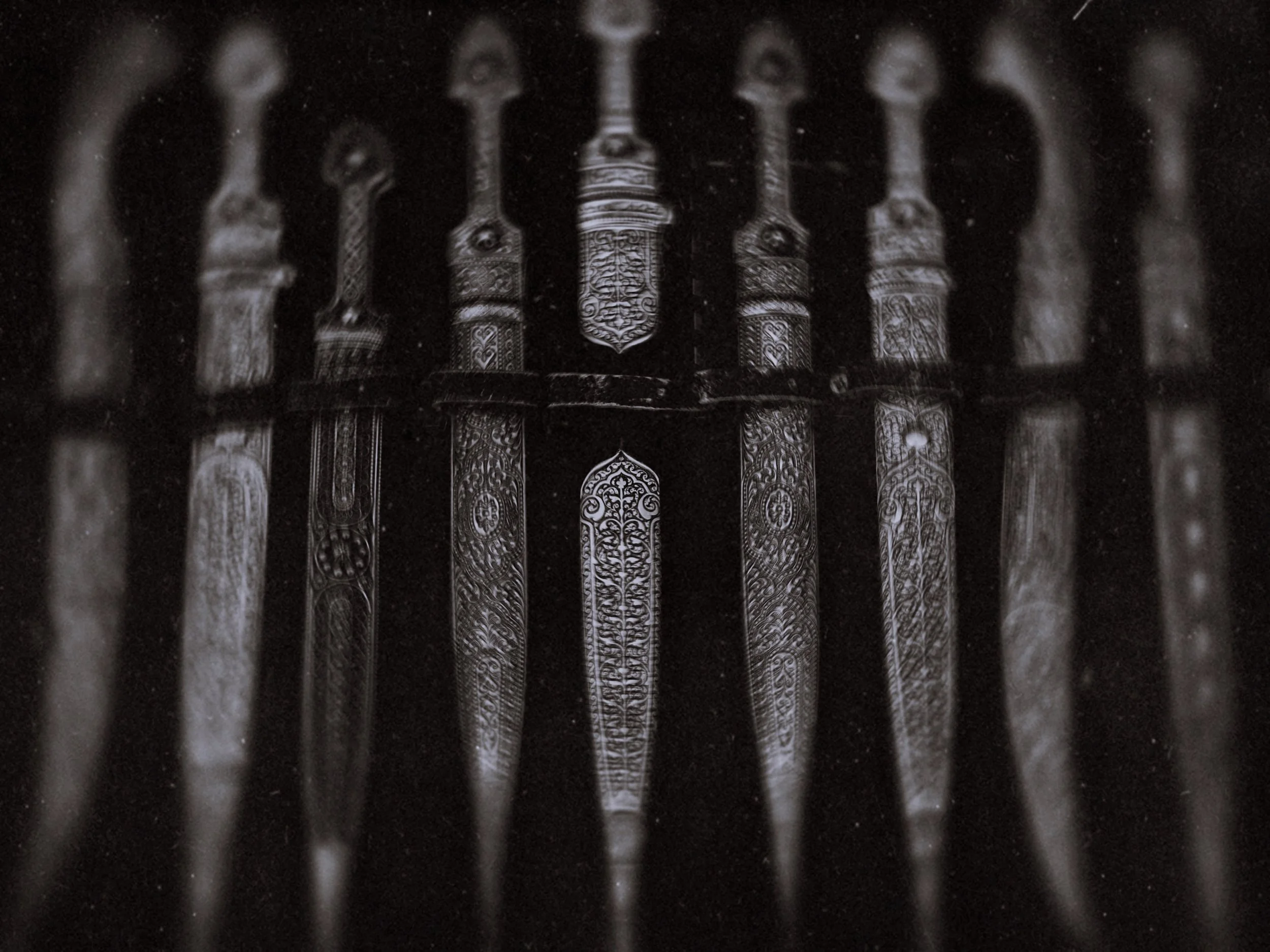
Photo by Roman Odentstov, edited by me.
What?
What?
Was it breaking through?
Hope, the thin argent splinter under skin.
Was it escaping?
A sigh gone feral in the cage of ribs—
Or was it an opinion that screamed behind the ladders of your mouth?
Was it reaching down?
That old amalgam: wrath and melancholy,
gulped back again because someone was an asshole?
Yes. It had begun its small insurrection,
some famished semaphore beneath the blood.
But:
Was it trying to get your attention?
Was it opening something?
Perhaps it wanted to open your legs
or unlatch the ossuary tucked behind your sternum,
or gnaw some third door that has no hinge at all.
Or was it only your throat, speaking a language it hadn’t been given yet?
Marni Fraser
0829|2026
V:XL PM
An Aperture Adjacent by Marni Fraser | 2026
Sometimes
Sometimes Something
I
I have a thought that comes to me like this:
even after all the lavished years,
the laugh that set his vanished youth afire,
the smell of smoke as my kiss climbed his neck.
He rose up from the margin of the night,
rock-and-roll thin, wrapped in leather, liner—
as though the dark had fashioned him a face.
He looked like death.
In a city built for the dead, he brought me
something I still can't say is life —
only that it moved, and seemed itself alive,
and I believed it was the light of morning
until I’d seen it was only ever the moon, borrowing.
II
Sometimes something wakes that ache in me,
that old anticipation without cause—
but now it fastens itself to nothing human.
It comes when evening gathers in the trees,
when something nameless moves beneath the sea,
and I think of a city built for the dead
and long for it.
I dream about the trees, even as they die,
and long to meet the sea inside its storms.
I dream of deer whose silence watches back,
of owls turning darkness into sound,
of fish beneath the undecipherable blue.
I think perhaps they are not unlike us,
or we were once more nearly kin to them;
that somewhere underneath the human tongue
their older tongue still talks in me,
and learning it enough could make me stay.
And then I feel the rain's mouth on my skin,
then the wind move like a hand between my limbs,
and for a moment I forget the bombs,
and the world's hunger, its mouth turned on itself.
And then I know what I have always loved:
the natural world, indifferent and immense;
the sea not needing to know my depths,
the trees seasonally meeting with death,
the creatures innocent of our despair.
And night, whose face I recognize the most—
wearing the shadow that the moon has stitched
across its brow, as if the dark itself
were something sacred enough to be adorned,
while somewhere underneath its ancient grace
the world turns, innocent of my existence.
Marni Fraser
0810.2026
VIII:XII PM
Image 2026
The Second Straw
The Second Straw
The moment that breaks the camel isn’t enough.
Two straws are needed.
Eons stretch while waiting
as one sun dips into another moon
and the weather changes.
There isn’t a single hope.
Just the knowing people lose their humanness.
Even now? Love is the small evidence:
a hand beneath, cradling a head
just before the skull strikes the floor,
the sentence someone keeps in a closed mouth
because saying it bothers
—even saying it carefully,
a child asleep upon a shoulder,
not yet given a thousand permissions
by which adults injure each other.
You love what passes between people
more than the people themselves—
the cup of water,
the coat held open,
the five honest words
that alter an unbearable day.
Who could spend an entire life
protecting such things?
That’s the difficulty.
That’s the difficulty.
Some creatures survive
by presenting less of themselves.
Certain seeds remain closed
through years of favorable weather,
waiting for fire.
A wounded animal sometimes travels
far beyond the herd
before lying down.
There are flowers that fold
at the pressure of a fingertip
and remain folded
long after the hand is gone.
None of this cancels tenderness.
Water still gathers
in the smallest hollow.
A bird with one good wing
still covers its young.
But every living thing
has some knowledge
of when nearness becomes danger,
when shelter becomes exposure,
when the kindest last act
is to leave no soft part
within reach.
Elsewhere, smaller things endure:
one perfect sentence,
a room without rules,
distant laughter arriving
through somebody’s wall,
the warmth left in fabric
after a decent body rises.
Sometimes that is enough.
Then comes the second straw.
Nothing remarkable in itself.
A dry length of grass,
almost without weight,
until the spine knows.
Not cruelty—
that knowledge is ancient.
Something smaller.
How little weight
is required
once enough has already been carried.
The camel does not collapse.
That would be easier.
The knees straighten.
The load slides sideways.
And across the ground
lie all the things
once mistaken
for belonging.
Marni Fraser
0808|2026
[X:XXII PM]
Photo Marni Fraser | 2026

Night Blight
Night Blight
The night drops
from its silver stem,
heavy as fruit,
sinking into the socket
of the earth's closed eye.
Night flowers open their sex,
the scent lingering down
city and country lanes,
bursting past themselves,
lost, then twisted—
in hair, skin, thin cotton,
caught in a sleeve, sleeping in wet cloth—
even morning loses its trail.
It never leaves,
like the scent of the spur and its bud
hanging around the lips of my mouth,
the drip that was on my chin,
the tips of my fingers,
and somewhere beneath my tongue
where I can't wash it away.
Beautiful blight—
so deep into the night
the birds forget their names,
the night birds tangled with the bats,
winged things stitched into my hair,
your mouth still near my ear,
and the nectar in this,
enough to drown a whole season—
and us wild in moonlight because
I am one of the growers now,
opening so wide
the night opens with me,
flowers ending at my wrists,
beginning again in my mouth.
The taste hasn't left.
Sweet, secret, then stolen,
still blooming somewhere past my throat—
and I have started to prefer
the wrong of it
to any sugar I once knew.
Marni Fraser
VIII • I • MMX
II:LII PM
Flowers #2 | 2026
Your Silhouette
Your Silhouette
(with Chopin's Nocturne in E minor, Op. 72, No. 1)
My silhouette,
the hours are resending.
Each one returns with music in it,
bending the air around the same
unfinished sorrow.
I see your hands.
I hear your soft laugh.
But your smile will not come to me.
It stays beyond the music,
somewhere in its own land.
The nail of the moon barely shows.
Night birds make their sad, small notes.
At the rim of the sky
a tree is bent gently,
and in its thin black shoulders
I see your silhouette.
Nâreshin is folded into another hour.
Its distance has no opening.
Young women laugh on its corner,
and their laughter travels backward
toward the boy you were.
How little you knew
how wanted you must have been—
how wanting stood around you
without casting a shadow.
And I am here, so far.
No one knows I am dreaming of you,
not even the moon confesses it.
And then alone,
I suddenly know that
no one hears the atrium
when it falls asunder.
No one sees the mountains inside it
toppling into unyielding rivers,
or the rivers running away
with my courage.
Only your silhouette remains—
thin, almost unfinished,
keeping its place in me
after every other image closes.
It keeps me hungering
for another sunrise.
You are the only shape the morning keeps.
This is not happiness.
Perhaps it is the birds,
their sad notes worrying the darkness
until my tears begin.
Perhaps it is E minor
opening and closing
like a black fan in the room.
Perhaps Chopin turns in his grave
because I have made a dead man
carry the absence of a love.
But it is true:
first, the silhouette.
Then the eternal.
Then the laugh—
startlingly sweet—
then the strange friendship
which had no proper name
and entered everything.
Now the nocturne is ending.
The air is not.
And still,
your smile does not come.
Only the shoulders of the tree.
Only the thin, dark shape of you.
Only the moon's small nail,
holding the night in place
while I am left beneath it.
Marni Fraser
0703.2026
IV:V P.M.

Hummingbird Houses | 0714.2025 | Canon EOS R
The Apple Of The Eye Is Usually Bruised
The Apple of the Eye Is Usually Bruised
I am saying Goodbye again—
As though goodbye is a door
and not the hand returning
to the same cold knob.
How many of us leave,
then return to the block
to see whether the house
has ever come to miss us?
I know.
There is nothing new under the sun.
Still, every morning
the sun drags its gold razors
across the waiting wound
and calls it Dawn.
I have dreamed of better rooms—
windows without fingerprints,
beds that do not recall
the weight of what they're missing,
a mirror that does not see
the last face standing before it
like a dead tenant
who can't move out.
But there is a hunger that repeats,
wearing a different mouth each time.
Only the same orchard
Carrying another season.
Only the same root
flowering under another color.
I am saying goodbye again.
How many of us say it
with one breath still held?
How many wave from the train
while wishing the train
will break down?
How many of us call someone
the apple of our eye,
not knowing the ache in our teeth
for the sweetness we were named for?
Even spoiled, the apple shines.
Its red skin keeps the evening.
Its sweetness darkens quietly
around the worm.
And still we lift it to our mouths.
And we call the rot a blessing.
And still, we bite near the bruise
and let the sweetness lie to us.
But tonight I am.
Tonight I'm putting it down.
Let the worn sun rise
over the salt-white ruin.
Let the window stare out
without me.
This is my hand waving—
not a white flag,
not a plea,
but the moon in its darkest hour,
when every eye has gone to sleep—
finally alone enough to be free.
I am saying goodbye again.
This time
I don't turn around
to watch myself disappear.
Marni Fraser
05.2026
XII:XI P.M.

Little Suns | 0704.2014
My Life Without Its Art
My Life Without Its Art
Sadness returns with its exacting aim
and finds the seam I thought had been repaired.
Why do I open rooms beneath my skin
for lives that enter, then depart,
their false names folded in the vanished hours?
They take the private radiance I give,
then cross the guarded borders of the flesh.
By morning, even anger has withdrawn.
I wake beneath the sadness they have made,
ashamed I thought the door and hours were ours.
And now my body alters as I watch.
An ancient woman walks through all my rooms;
she wears my face and drags my limbs through fire,
arranging all her years and weight beneath
my skin. She drinks the iron from my blood
and leaves me nothing I can live upon.
My heart misfires; its clusters flower
in white, meticulous violence behind
an eye that once could apprehend each shade.
I miss the sharp precision of my hands,
the graphite dusk, the gold obeying breath.
I told my love: I cannot stay alive
without my stories fastened to my eyes,
without my stories waking in my hands.
The world extends its help in clinical spoons.
I only want my art. I want what's mine.
No one will kneel beside this dwindling life.
No one ever has. No witness sees
me gather all the pigments to my breasts,
or brushes hardening slowly in their jars.
My unfinished figures now turn away,
as though they, too, have learned to leave me here.
Why did they hate the softness I disclosed?
Why was my trust a room to vandalize?
Why does my own blood organize against me?
I gave them everything in me that gleamed.
Now even sorrow cannot draw my face.
It only signs its name
where mine had been.
Marni Fraser
0720|2026
VIII:XXVII A.M.

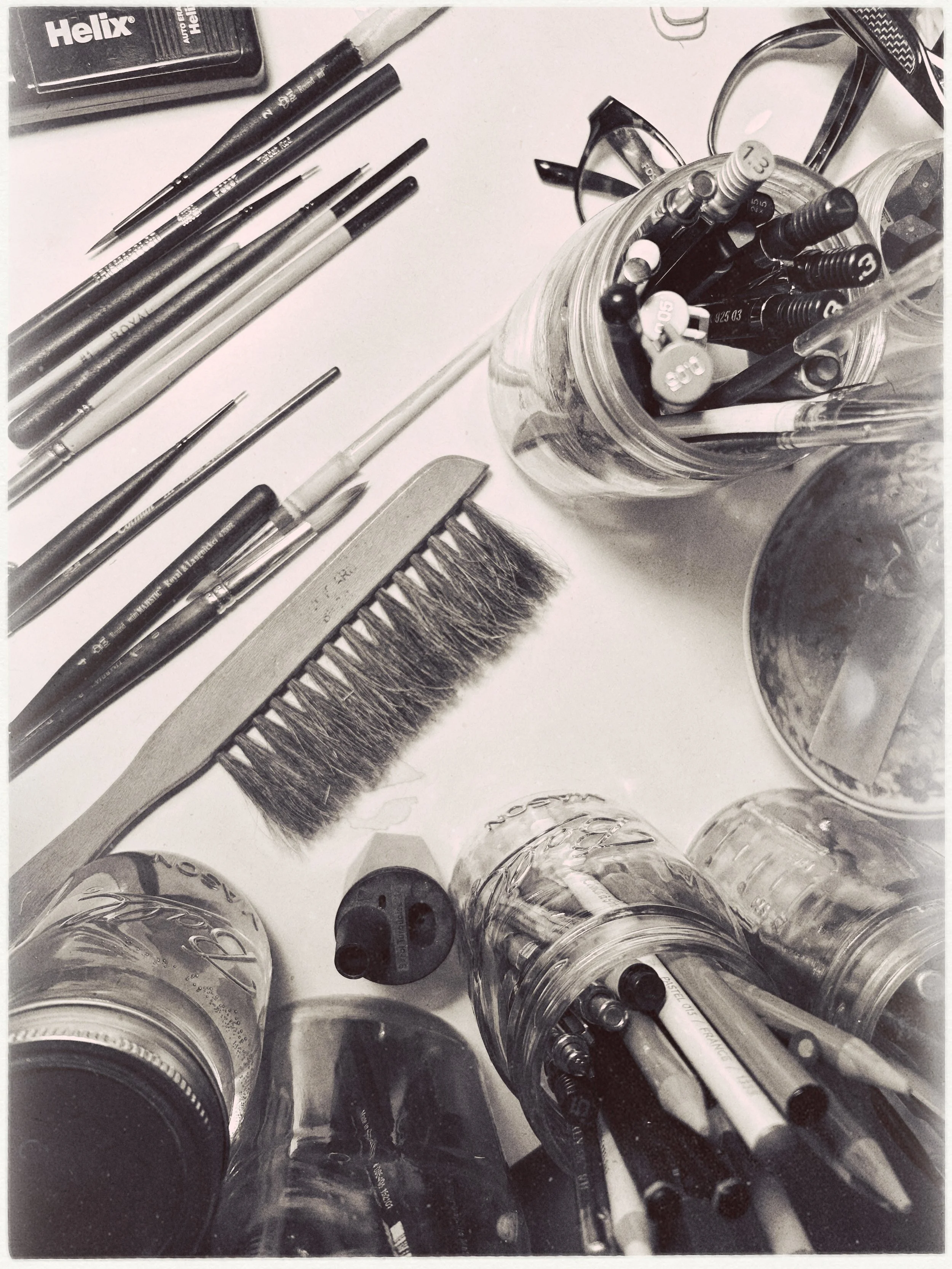
The Table | 05.2024