The Discipline of Leaving
One of the most remarkable abilities human beings possess is adaptability—the ability to change where we live, how we live, and what we allow into our lives in order to make existence more habitable.
If something doesn’t work, change it. If a place doesn’t work, leave it. If a person consistently brings dishonesty, misery, or disrespect into your life, move on.
When we are doing our best to live honestly and encounter people who operate through deception, manipulation, or cowardice, we are under no obligation to remain there at the expense of our own well-being.
I believe human beings are profoundly adaptable, and that somewhere beneath all the noise, we usually know what is right for us. We owe it to ourselves to honor that knowledge.
We work too hard to earn our self-respect, autonomy, discernment, and wisdom to surrender them simply because someone else cannot meet us with the same integrity.
There is no virtue in lowering your standards to accommodate shitty people.
Marni Fraser
1018.2026
Image | 2026
Sometimes
Sometimes Something
I
I have a thought that comes to me like this:
even after all the lavished years,
the laugh that set his vanished youth afire,
the smell of smoke as my kiss climbed his neck.
He rose up from the margin of the night,
rock-and-roll thin, wrapped in leather, liner—
as though the dark had fashioned him a face.
He looked like death.
In a city built for the dead, he brought me
something I still can't say is life —
only that it moved, and seemed itself alive,
and I believed it was the light of morning
until I’d seen it was only ever the moon, borrowing.
II
Sometimes something wakes that ache in me,
that old anticipation without cause—
but now it fastens itself to nothing human.
It comes when evening gathers in the trees,
when something nameless moves beneath the sea,
and I think of a city built for the dead
and long for it.
I dream about the trees, even as they die,
and long to meet the sea inside its storms.
I dream of deer whose silence watches back,
of owls turning darkness into sound,
of fish beneath the undecipherable blue.
I think perhaps they are not unlike us,
or we were once more nearly kin to them;
that somewhere underneath the human tongue
their older tongue still talks in me,
and learning it enough could make me stay.
And then I feel the rain's mouth on my skin,
then the wind move like a hand between my limbs,
and for a moment I forget the bombs,
and the world's hunger, its mouth turned on itself.
And then I know what I have always loved:
the natural world, indifferent and immense;
the sea not needing to know my depths,
the trees seasonally meeting with death,
the creatures innocent of our despair.
And night, whose face I recognize the most—
wearing the shadow that the moon has stitched
across its brow, as if the dark itself
were something sacred enough to be adorned,
while somewhere underneath its ancient grace
the world turns, innocent of my existence.
Marni Fraser
0810.2026
VIII:XII PM
Image 2026
The Second Straw
The Second Straw
The moment that breaks the camel isn’t enough.
Two straws are needed.
Eons stretch while waiting
as one sun dips into another moon
and the weather changes.
There isn’t a single hope.
Just the knowing people lose their humanness.
Even now? Love is the small evidence:
a hand beneath, cradling a head
just before the skull strikes the floor,
the sentence someone keeps in a closed mouth
because saying it bothers
—even saying it carefully,
a child asleep upon a shoulder,
not yet given a thousand permissions
by which adults injure each other.
You love what passes between people
more than the people themselves—
the cup of water,
the coat held open,
the five honest words
that alter an unbearable day.
Who could spend an entire life
protecting such things?
That’s the difficulty.
That’s the difficulty.
Some creatures survive
by presenting less of themselves.
Certain seeds remain closed
through years of favorable weather,
waiting for fire.
A wounded animal sometimes travels
far beyond the herd
before lying down.
There are flowers that fold
at the pressure of a fingertip
and remain folded
long after the hand is gone.
None of this cancels tenderness.
Water still gathers
in the smallest hollow.
A bird with one good wing
still covers its young.
But every living thing
has some knowledge
of when nearness becomes danger,
when shelter becomes exposure,
when the kindest last act
is to leave no soft part
within reach.
Elsewhere, smaller things endure:
one perfect sentence,
a room without rules,
distant laughter arriving
through somebody’s wall,
the warmth left in fabric
after a decent body rises.
Sometimes that is enough.
Then comes the second straw.
Nothing remarkable in itself.
A dry length of grass,
almost without weight,
until the spine knows.
Not cruelty—
that knowledge is ancient.
Something smaller.
How little weight
is required
once enough has already been carried.
The camel does not collapse.
That would be easier.
The knees straighten.
The load slides sideways.
And across the ground
lie all the things
once mistaken
for belonging.
Marni Fraser
0808|2026
[X:XXII PM]
Photo Marni Fraser | 2026
Who Feels It?
Friendship has been difficult to locate. Support, in the hours that actually required it, has been nearly impossible. There is a particular loneliness in wanting someone to confide in, someone to let off a little steam with, and discovering that this is not available to you. I no longer know if it is available to anyone.
So I ask myself: why pretend I have friendships I don’t have? Why insist that I need them when the people who claim to be my friends give me nothing when I actually need them?
If you sit in a room full of people and feel tension instead of ease. If their jokes don’t land. If you can feel yourself being sized up, or you catch yourself sizing them up in return — you may simply be a person who does not enjoy the company of other people. And you may have spent your whole life being told this is a defect. That there is something wrong with you if you are not properly socialized, properly networked, properly folded into the herd.
But if most people make you feel worse for having been in the room with them, what exactly is the alternative? Stay because we’ve collectively decided that everyone is supposed to want company? Keep entertaining conversations that bore you past the point of politeness? Or leave, cleanly, and let the whole exchange be what it actually was: a pleasant enough conversation with a stranger you don’t know and don’t intend to.
I have chosen the second one.
I like talking to strangers. I don’t mind that we say goodbye and never speak again, because that is what happens, and it is more honest than spending years calling someone a friend before learning they were trading your information to other women online, laughing about you to an audience, discussing you with your own friends behind your back, making you the villain, sending other people after you, or doing whatever particular fucked-up thing they do to justify themselves.
I have had that experience enough times. I am done having it.
I am tired of crying because people used what I gave them as ammunition. Tired of finding out, always secondhand, what was said about me. Tired of reading the little posts. Tired of watching the little games play out in public while everyone involved assumes you’re too fucking stupid to understand what you’re looking at.
None of it was worth what it cost me.
I am angry. I am hurt. I am not interested in pretending otherwise for your comfort.
Here is what I have concluded: a lot of people do not have much capacity for depth. They either do not feel things very intensely, or those feelings do not extend very far beyond themselves. I don’t know how people like that form bonds that are anything other than shallow. Maybe they don’t. I am not claiming to be the healthiest person alive, or the kindest, or the most impressive. But I know exactly what I will tolerate and what I will not. At this point, that matters more to me than being liked.
You want to know what exists, if not friendship, if not loyalty, if not the people who are supposed to show up?
Survival exists.
Accountability to yourself exists.
Doing the correct thing when there is pressure to do otherwise — that exists.
That is sufficient. It has to be.
And to anyone reading this who knows me personally: if you have noticed my silence, it is not an accident. It is because you crossed a line I do not renegotiate. You lied to me. I found out. And I am finished.
There are two or three of you circulating out there right now to whom I offered nothing but support, and I withdraw it.
I do not want to see you.
I do not want to hear from you.
I do not want you within twenty feet of my life.
And on the small stretch of time I set aside to unwind — to curate something of my own, undisturbed — I do not want your face, your taste, or your work anywhere near my feed.
I have had enough of this from people who treat other people as disposable.
Consider, before you do it again, that someone wrote this about you.
Blue by Marni Fraser | 08.2026
Today’s Fire Report
“I’m done” is the creative person’s “just one more episode” — a phrase you say with total conviction while already knowing you’ll be back in the shit by Thursday. It’s not a decision, it’s a genre of sentence. smiles
The climate tally, since I’m naval gazing a ranking of civilizational collapse:
• Political climate: on fire
• Environmental climate: also on fire, and it’s the fire’s fault the other fire started (that can be political as well.)
• Personal circle climate: standing in the middle of both fires holding a clipboard, unbothered. Can’t give a f**k.
All three tanking at once isn’t bad luck, it’s just Tuesday having last sputtering’s of fuck you energy. And is indeed a positive. On live television today, and focus being “art” for October’s exhibit. And somehow the only three things left upright are my life (and the two in it) school, and solitude — the three least dramatic nouns in this life, quietly holding the roof up while everything else becomes a coordinated collapse.
Out of hand.
Ps. Sorry I don’t post pictures of Vegas, but it’s hotter than Death Valley out here, and I’m not seeking to become a crispy critter. I stay indoors. (Typical cliche dark artist b.s., or some such nonsense.)
Photo 2025
Night Blight
Night Blight
The night drops
from its silver stem,
heavy as fruit,
sinking into the socket
of the earth's closed eye.
Night flowers open their sex,
the scent lingering down
city and country lanes,
bursting past themselves,
lost, then twisted—
in hair, skin, thin cotton,
caught in a sleeve, sleeping in wet cloth—
even morning loses its trail.
It never leaves,
like the scent of the spur and its bud
hanging around the lips of my mouth,
the drip that was on my chin,
the tips of my fingers,
and somewhere beneath my tongue
where I can't wash it away.
Beautiful blight—
so deep into the night
the birds forget their names,
the night birds tangled with the bats,
winged things stitched into my hair,
your mouth still near my ear,
and the nectar in this,
enough to drown a whole season—
and us wild in moonlight because
I am one of the growers now,
opening so wide
the night opens with me,
flowers ending at my wrists,
beginning again in my mouth.
The taste hasn't left.
Sweet, secret, then stolen,
still blooming somewhere past my throat—
and I have started to prefer
the wrong of it
to any sugar I once knew.
Marni Fraser
VIII • I • MMX
II:LII PM
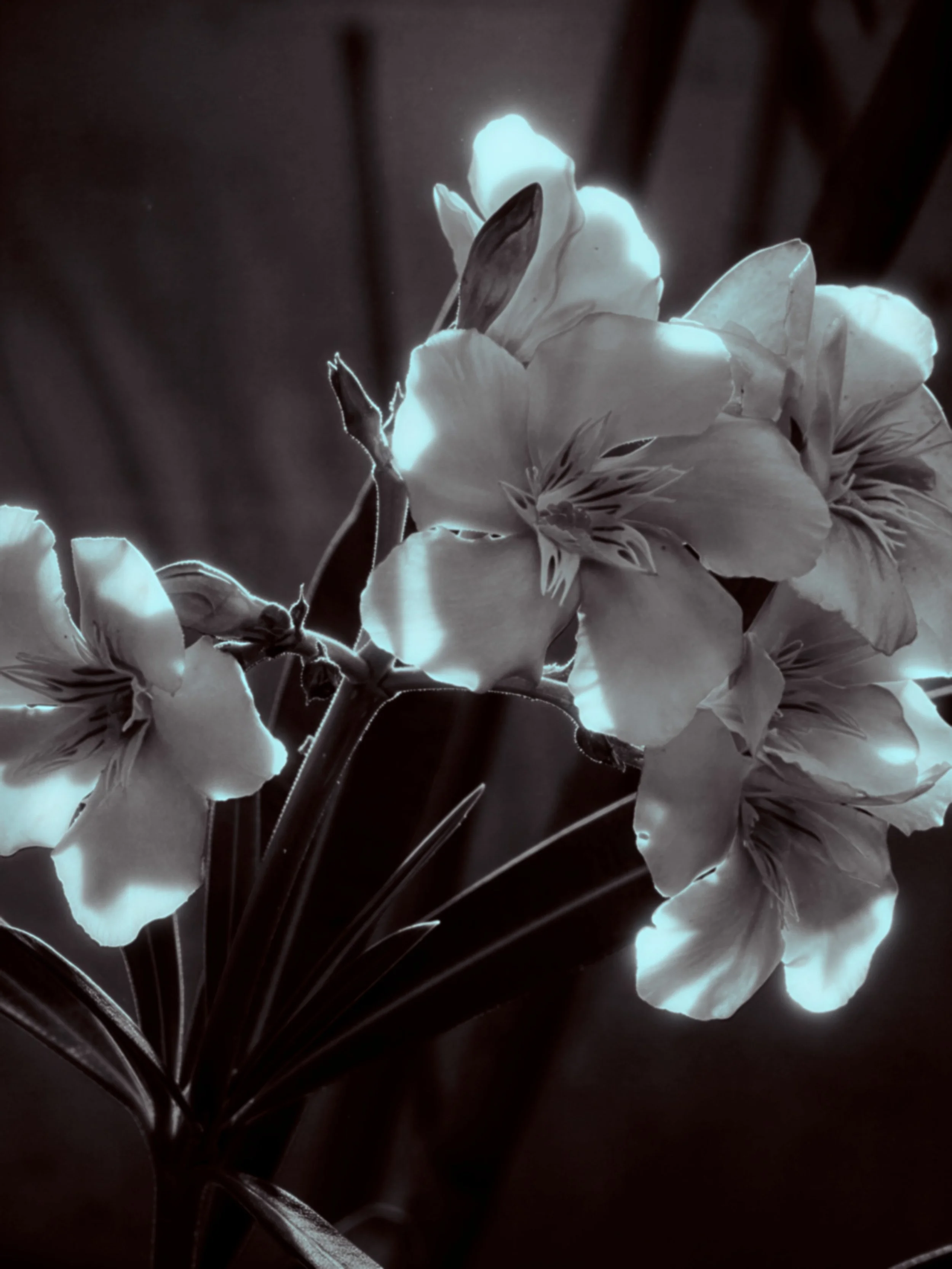
Flowers #2 | 2026
Your Silhouette
Your Silhouette
(with Chopin's Nocturne in E minor, Op. 72, No. 1)
My silhouette,
the hours are resending.
Each one returns with music in it,
bending the air around the same
unfinished sorrow.
I see your hands.
I hear your soft laugh.
But your smile will not come to me.
It stays beyond the music,
somewhere in its own land.
The nail of the moon barely shows.
Night birds make their sad, small notes.
At the rim of the sky
a tree is bent gently,
and in its thin black shoulders
I see your silhouette.
Nâreshin is folded into another hour.
Its distance has no opening.
Young women laugh on its corner,
and their laughter travels backward
toward the boy you were.
How little you knew
how wanted you must have been—
how wanting stood around you
without casting a shadow.
And I am here, so far.
No one knows I am dreaming of you,
not even the moon confesses it.
And then alone,
I suddenly know that
no one hears the atrium
when it falls asunder.
No one sees the mountains inside it
toppling into unyielding rivers,
or the rivers running away
with my courage.
Only your silhouette remains—
thin, almost unfinished,
keeping its place in me
after every other image closes.
It keeps me hungering
for another sunrise.
You are the only shape the morning keeps.
This is not happiness.
Perhaps it is the birds,
their sad notes worrying the darkness
until my tears begin.
Perhaps it is E minor
opening and closing
like a black fan in the room.
Perhaps Chopin turns in his grave
because I have made a dead man
carry the absence of a love.
But it is true:
first, the silhouette.
Then the eternal.
Then the laugh—
startlingly sweet—
then the strange friendship
which had no proper name
and entered everything.
Now the nocturne is ending.
The air is not.
And still,
your smile does not come.
Only the shoulders of the tree.
Only the thin, dark shape of you.
Only the moon's small nail,
holding the night in place
while I am left beneath it.
Marni Fraser
0703.2026
IV:V P.M.

Hummingbird Houses | 0714.2025 | Canon EOS R
The Apple Of The Eye Is Usually Bruised
The Apple of the Eye Is Usually Bruised
I am saying Goodbye again—
As though goodbye is a door
and not the hand returning
to the same cold knob.
How many of us leave,
then return to the block
to see whether the house
has ever come to miss us?
I know.
There is nothing new under the sun.
Still, every morning
the sun drags its gold razors
across the waiting wound
and calls it Dawn.
I have dreamed of better rooms—
windows without fingerprints,
beds that do not recall
the weight of what they're missing,
a mirror that does not see
the last face standing before it
like a dead tenant
who can't move out.
But there is a hunger that repeats,
wearing a different mouth each time.
Only the same orchard
Carrying another season.
Only the same root
flowering under another color.
I am saying goodbye again.
How many of us say it
with one breath still held?
How many wave from the train
while wishing the train
will break down?
How many of us call someone
the apple of our eye,
not knowing the ache in our teeth
for the sweetness we were named for?
Even spoiled, the apple shines.
Its red skin keeps the evening.
Its sweetness darkens quietly
around the worm.
And still we lift it to our mouths.
And we call the rot a blessing.
And still, we bite near the bruise
and let the sweetness lie to us.
But tonight I am.
Tonight I'm putting it down.
Let the worn sun rise
over the salt-white ruin.
Let the window stare out
without me.
This is my hand waving—
not a white flag,
not a plea,
but the moon in its darkest hour,
when every eye has gone to sleep—
finally alone enough to be free.
I am saying goodbye again.
This time
I don't turn around
to watch myself disappear.
Marni Fraser
05.2026
XII:XI P.M.

Little Suns | 0704.2014
My Life Without Its Art
My Life Without Its Art
Sadness returns with its exacting aim
and finds the seam I thought had been repaired.
Why do I open rooms beneath my skin
for lives that enter, then depart,
their false names folded in the vanished hours?
They take the private radiance I give,
then cross the guarded borders of the flesh.
By morning, even anger has withdrawn.
I wake beneath the sadness they have made,
ashamed I thought the door and hours were ours.
And now my body alters as I watch.
An ancient woman walks through all my rooms;
she wears my face and drags my limbs through fire,
arranging all her years and weight beneath
my skin. She drinks the iron from my blood
and leaves me nothing I can live upon.
My heart misfires; its clusters flower
in white, meticulous violence behind
an eye that once could apprehend each shade.
I miss the sharp precision of my hands,
the graphite dusk, the gold obeying breath.
I told my love: I cannot stay alive
without my stories fastened to my eyes,
without my stories waking in my hands.
The world extends its help in clinical spoons.
I only want my art. I want what's mine.
No one will kneel beside this dwindling life.
No one ever has. No witness sees
me gather all the pigments to my breasts,
or brushes hardening slowly in their jars.
My unfinished figures now turn away,
as though they, too, have learned to leave me here.
Why did they hate the softness I disclosed?
Why was my trust a room to vandalize?
Why does my own blood organize against me?
I gave them everything in me that gleamed.
Now even sorrow cannot draw my face.
It only signs its name
where mine had been.
Marni Fraser
0720|2026
VIII:XXVII A.M.

The Table | 05.2024
Protecting What Is Mine
I decided to return to school. At my age, it isn’t easy. I went back to learn a technical skill.
This should make me happy, and in some ways it does. Still, only one person regularly asks how I’m doing or encourages me. My closer friends say kind things, but for the most part, school is treated as a fact about my life. Nobody asks much about it.
When younger people return to school, family and friends often gather around them with encouragement. For an older person, the root memory is different. More than thirty-five years of life has happened since I was last in a classroom. You carry all of that back in with you. The encouragement you quietly hope for does not always come.
Today I cried.
There was nobody to tell that I passed a quiz. Nobody to talk to about a subject that frightened me or a lesson I found difficult. Most people go to school and find some kind of clique, even a small one. There is no clique here.
Nobody shares in my joy.
Sometimes I feel discarded by people.
Still, I am realizing that my memory is sharp. Fear comes and goes. The only things that have ever truly mattered to me are the art and the writing. This new path is partly an attempt to give something back to the healthcare community that supported me for so long. For five years, I was receiving care twice a week, without any treatment that seemed to hold.
Eventually, there was a seizure.
Stress, age, the wear on my body, my inability to lift heavy objects or work in an environment that moves too quickly—all of it made me stop and consider what kind of work I could still do.
What I really miss is being myself.
I guess I really miss being myself. None of it feels like me. It feels like doable, bearable, and helpful. I don’t want to sugar coat it. The worlds changed and it’s not geared toward being a woman, or even human… maybe it never was or will be.
We all have to make our own way.
I am doing this to protect what is mine.
The art.
The writing.

Image | 2026
After Us
When they’re gone, I’ll be alone. Not because they love me—anyone can love from a distance—but because they fight for me. One is living through a war. One is watching her husband forget her, piece by piece, and still gets up. One has known me since I was fourteen. And my partner, who carries his own weight and, sometimes, mine too.
I know what that costs them. I know I’m lucky.
The war has begun again. It sits on my chest like something I swallowed wrong.
I live among people who’ve made peace with other people’s suffering—people who look at a woman and see a body to legislate, who look at the deaths of children and still choose the gun. Above them are those with power, wrapped in it, untouched by the consequences of what they govern.
But it isn’t the cruelty that guts me.
It’s the shrug.
The people who’ve decided their voice doesn’t matter, so why use it. Apathy is cruelty’s quiet accomplice.
I’m tired. Yet, I’m still determined. I don’t believe this is our ceiling.
There has to be something better waiting for the ones who come after us.

Image | 2026
Love Letter to Earth-Bound Creatives
Dear Artists, Poets, Actors, Musicians, and Picture-Takers,
These are poor times to be you. With AI, the non-artists, the hobbyists, the untalented and the unskilled, the daydreamers and those envious of our skills can take our tutors, our histories, our images and language, then claim the name of artist without ever having lived the life from which art comes. I say have faith. The word still means something, even if society has become afraid to say what it means honestly.
I am speaking to the artists whose work is the great drive of their lives: the actors, photographers, poets, painters, writers, musicians, and other strange makers who have given years to what they do and have been changed by the giving. A hobby can be pleasant, absorbing, skillful; it can even be beautiful—but it is not the same animal.
The artist has built a life around the work, and the work, in return, has entered the life and altered its shape. It has cost for years: sleep, money, love, comfort, certainty, and sometimes the approval of nearly everyone around you. You have failed at it and returned. You have worked when no one cared, when no one was looking, and when there was no promise that anyone ever would.
Perhaps you knew what you were before you knew the word for it. The world entered you strangely from the beginning and then decided not to remain in its original form. A face became unbearable beauty with light and shadow; silence had a certain kind of weight; perhaps a room composed itself into a picture before you held the camera. For me, a sentence followed me into sleep. Did it for you? How many of us have music living beneath our skin and drowning out the noise?
You noticed the small alteration in a person's voice, the exhausted bird on a wire, the violence of an ugly thought, the strange beauty of a hand resting on a table. Other people went on with their day while you carried these things in your breasts.
This is what I mean when I say the artist and the hobbyist are not the same animal. I do not say this to be cruel, and I will not lie in order to appear kind. A horse is not a heron, and neither is injured by the truth of it. They have different hungers, different instincts, different migrations, and very different ways of surviving winter. The hobbyist may love making something; the artist is altered by the need to make it. Artists are people who take what they do so seriously, with such discipline and for so many years, that the work can no longer be separated cleanly from the person who has made it. This letter is for them.
It is especially for them now, when the word artist is being stretched so thin that anyone who wants it may take it. A person can ask a machine for the appearance of a painting, a photograph, a poem, a song, a voice, and then stand beside the result as if desire and authorship were the same act, without understanding the difference or what that difference means to the artist. They can enter the houses built by dead and living artists, take from their rooms the hard work, blood, sweat, and tears, then rearrange the room and announce themselves as architects—ahh, the big lie.
Yet a machine can only imitate the evidence of a life. It cannot go backward and live one, nor can it spend twenty years teaching a hand to obey an eye, know the private humiliation of failing at the thing one loves most, or return the next morning to the table and piece because it has nowhere else to go. It cannot lose sleep over a line no one may ever read, nor stand before an unfinished work knowing that somewhere inside it is something true that one has not yet become capable of reaching. It cannot give its life to the work because it has no life to give.
So, in these times, Dear Artists, stay inside you. When the cities are overpopulated and you become overwhelmed, revel in nature. Go to the countryside to rehabilitate your senses and dump the ugliness others have placed upon you. Walk until their voices become smaller. Go somewhere no one asks you to explain your face, where your eyes can recover their distance and your body can remember the wind. Be as kind as you are and as short as you wish. Fulfill your desires where you can, make sense because you can.
Quietly snuff out the individuals and situations that exhaust your dreams and voice, that make you question, in all the wrong ways, your own inner compass and beliefs. There is a strange doubt that deepens an artist and also a sort of doubt that merely corrodes one; know the difference. Do not pass your compass around a room and ask other people to tell you where your direction is. Stay on the true love's oath of the creative, who is born somewhat apart and often with different thinking from most.
Do not contort yourself with others until you have learned your own boundaries, your own willingness, and your own desires. Otherwise, you risk being dragged into the poorest of places by those who, no matter how much love and compassion you give, will never change—because then you risk losing your vision, voice and entire self. Some people can take from you endlessly and still call what you have insufficient. Please do not empty yourself again and again to prove the size of your heart, gentle soul.
Guard your heart and head fiercely, because the work requires reserves and the world is full of people and situations that will use them without understanding what they have taken. In this world there are disciplined, passionate, curious people who rise above themselves, and there are people who will need your understanding while making no effort to understand you. Give what is yours to give, but do not let a few poor people disarm your love. As an artist, love is part of you, and part of what you use to make sense of the world.
Always speak the truth softly when you can. Always stand in another's shoes, but never walk so far in them that you lose yourself.
For artists who work among others, you never owe your coworkers or a company your soul. It is all right to do an excellent job and enough to be cordial. A wage purchases your labor; it does not purchase your inner life. You do not have to turn yourself inside out for the comfort, curiosity, entertainment, or approval of people simply because you share a building and a schedule with them.
Most people will never fully understand you, much less like you, and you must not build your life around trying to correct this. Some people dislike what they cannot read, and some envy what they cannot locate in themselves. Envy has many disguises and often arrives disguised as concern, correction, advice, a joke made once too often, or a small rewriting of what happened. You may be told that what you know happened did not happen, that what you see is not there, or that your sensitivity is the defect rather than the instrument by which you noticed the thing in the first place. Keep your compass. You are visionary.
Dear artists, just because people are pulled into your light does not mean you need to be bright just for them. Attraction is not yes, and curiosity is not deep intimacy. You can give a lot and feel little, and even then it is okay that you do. You can love humanity and dislike its company. You can be warm and private, generous and bold without being available, and you can even disappear for a while without having betrayed anyone.
Do not allow complaint to take away your childlike vivacity. There are enough forces in the world trying to make a person dull without your helping them.
Always remain full of yourself and bright. Stay outside the box, because it was built by someone who required straight walls and expected every living thing to fit inside them. The fear of that is not yours to carry. Let go when a person shows they cannot withstand your complexity without trying to punish, simplify, possess, diagnose, or reduce it.
Do not tolerate disrespect, and do not make yourself small to satisfy someone's curiosity. There is a terrible difference between being seen and being inspected, and an artist should learn it early and well. This is your protection against the many wars that will be waged on you by individuals and society.
Most important, stay with the ocean and its birds, the wind that constantly changes but is steady in its mercurial nature. Stay with the cats and dogs, the horses and animals that are just like you: alert, particular, alive to what approaches. Stay with the birds whose wings carry your heart, and that sing just for you and for anyone willing to listen. Stay with the insects that give back what they take. Stay with the sky that is infinite and the ground that steadies your stance and steps.
The natural world does not ask for your soul, but guides it gently into the hours. The ocean does not care whether your work sold, and a horse does not ask how many people follow you. A small animal does not confuse obscurity with failure. The trees and flowers have no committee before which you must defend the strange direction of your growth. Stay there until your senses return and you remember the old proportions: one body, one life, the ground beneath your feet, and above it a sky so large that the opinions of a cruel person and society become what they always were—minor.
Perhaps you have not always been too much. Perhaps, sometimes, you have simply been too long in the wrong habitat. Society is forever praising the creature that adapts to the cage and wondering what is wrong with the one who cannot sing inside it. The living world asks no such thing of you. It does not require you to become less strange before allowing you to belong.
Stay with other artists who remain somewhere inside themselves like children and try. Not childish, but still capable of astonishment; still willing to kneel in the dirt and look closely at a beetle, a broken cup, a sad hour, or a stranger's stance. Stay with those who ask what something is before asking what it is worth, who can spend an afternoon, or a year, or a life on what another person calls useless. Stay with those who know the humiliation of starting again, who can look at another artist's work and feel wonder without immediately wanting to possess the wonder for themselves, and who still have reverence.
Dear artists, you are not talented AI users. You are not hobbyists, and you are not average in your relationship to the work. You are a certain freedom under the skin, a voice and a visionary giving form to what had been overlooked in others. You are the eye that refuses the first appearance of things, the ear beneath the uncertainty, the hand that returns in spite of aches, the body willing to become another life beneath the lonely nights. You are life looking back at itself, never leaving the experience untranslated.
Do not fear their reaction to you. It is not worth folding yourself into something so small that you fail to exist. Find the other strange ones who are still trying. Then go home, close the door, and return to your works and love.
© Marni Fraser
0706.2026
9:16am
Image | 2026
FREEDOM
and all without my hands to fix it.
FREEDOM
PART 1
Freedom won by turning the mirror
to watch the thing behind me—
to finally walk into its own proportions,
survive its own weather,
wear its impossible shape—
and all without my hands to fix it.
There's a freedom
that comes as numbness comes—
as the body abandoning
a place it has been pierced too often,
and always without mercy.
And just before surrender,
one kept peeling back
what they thought was their own skin,
only to discover
they were wearing another season,
some other person's weather,
and carefully wore it upon the shoulders
until they forgot where they ended.
And in the freedom,
the flowers have not somehow transformed
but were always this bright.
And after the rain,
when the asters didn't deepen,
the creosote did not gather into
a new shade of green either.
It was my eyes all along
that finally stopped kneeling—
and simply looked.
And in seeing, the last tears
didn't dissolve into the ground—
They gathered in my palms
like little glass beads,
like ruin trying to return—
that no longer belonged
inside my skin—
⸻
PART 2
and behind me,
Pierrot had lived inside the act so long
it became his face.
The audience were all clowns.
Who knew?
I did.
Who knew carnival lights
were nailed to boards,
bright enough to fool the road,
and never the daylight.
Who knew?
I did.
Why linger?
There is freedom
in no longer asking the compass.
The compass only lands
on an idea of a place
no longer existing
for me.
I was the one
walking circles around it,
calling it my journey.
There is freedom
when it finally stands
without asking
to look directly at itself.
Freedom
because I have stopped
erasing another person's outline.
My feelings inside
fractured—
river ice giving way—
one long interior sound,
then water
doing what it intended
all along.
And I no longer love the bird
kept in this house—
so I opened its window.
And I no longer wait
for a voice
that always belonged
somewhere else.
So the man-made prison burns.
And yet
not really gloriously.
No.
It blackened quietly,
moons ago—
beam by beam,
until dawn
could no longer remember
where to cast its shadow,
and only ash remained
with the shape
of what it once contained.
I turned the ashes over
until nothing remained.
Then wished
to become myself again.
The misfortune
of arriving
at the wrong fate
is sometimes
the only door
through which
the truth
at last
enters.
© Marni Fraser
0702.2026
[Ⅻ · 33]
Image | 2026
Small Update
From this point forward, I will no longer be available for personal texts or messages on any platform. Too often, openness isn’t met with effort or care. I no longer have the energy to continue investing where it isn’t reciprocated.
My values belong to another era. I believe friendship requires effort, loyalty, and the courage to show up for people. I expect those things.
I’m returning to work after several difficult months away, and I’ve begun school. Those two things deserve my full attention. After today, I won’t be available to adjust my schedule, provide emotional support, or socialize beyond what my work requires.
Life is short. Most people are understandably focused on their own lives, goals, and priorities. I intend to do the same.
From today forward, I am available for work inquiries only.

Hands | Real Bodies Exhibit | Marni Fraser
TO BIND TO FINISH
A Binding, Darker Wrought
By blood unshed and bone unbroke,
By the black hour when no cock hath spoke,
I bind thee, shadow, in thy own coil,
I bind thee, serpent, in thy own soil.
Let thy tongue turn to ash in thy mouth,
Let thy compass forget the north and the south,
Let every door thou wouldst enter be wall,
Let every hand thou wouldst raise, wear a pall.
By the worm that turns beneath the stone,
By the crow that picks the field alone,
I call the dark to eat the dark in thee,
I call the rot to catch what tries to flee.
Thy name I do not speak, nor need I speak it—
The binding knows its mark, and shall not break it.
Let thy nights be long and thy mornings thin,
Let the thing thou art be caged within.
Not death I ask, but stillness absolute,
Not blood, but silence at the very root.
So let it stand, unblessed, unbroke, unspoken—
Sealed till the seal itself lies broken.
⸻
A Ward for Myself
Now round mine own head I draw the ring,
Round mine own heart, a guarded thing.
No shade returning, no third fold cast,
Shall cross this line, or hold, or last.
What I have loosed, I loose alone—
It walks not back to flesh or bone.
No third fold turns to head or heart,
So sealed from end as from the start.
⸻
The Making of the Water
Sage laid in, and sulfur too,
Salt and smoke to season through,
Flowers from my grave, unmourned,
Candles spent, their banishing done,
At midnight, all laid down within the bowl,
Given to the elements whole.
Red string wound about the bowl,
Red string binding, red string whole,
Water taking what is placed,
Nothing wasted, nothing chased.
One drop only, given last,
Drawn from hours of drawing past,
Falls into the water still—
Blood to close what is my will.
So the water holds it all,
So the working does not fall,
Sealed by hand and sealed by art,
Sealed by what came from my part.
⸻
Marni Fraser
2026
Ⅻ · ○○

Self | 2026
Vanishing
Vanishing
“One gives way to one’s greatest fear
only after the deepest bond
has exhausted its last resistance.”
The moon gives way along a hidden seam:
A white vessel split upon the dark,
its flawless halves made sacred
only after the fracture.
Or the moon looks to me
like a plate broken into bright pieces,
only to become more beautiful
for having been held too dearly.
I have trusted myself to set sail
upon the black tide beneath constellations,
where a star keeps its bright mouth closed
to swallow an oath no one can witness.
No compass is cradled in my hand:
To watch how the water bends
toward an unseen harbor,
and to know I surrender
to its quiet certainty.
Even the darkness
knows where to deliver me.
Then you found another stone
to cast into a water already trembling.
My sadness arrives as a stranger
the stranger wearing your shadow—
the patient nightmare
that has always followed you,
feeding upon every sliver of light in you,
until only its own thirst and hunger remain.
And when it finally learns your name,
it will answer only to you.
You. Yourself,
Vanishing—
Marni Fraser
0630.2026
8:49am

Image by Daniel Torobekov | A mesmerizing starry night sky reflecting beautifully over the ocean and rock formations of Hawaii, USA.
Poem: Anyway
Anyway—
I am alone.
Perhaps I always was.
Isn't everyone?
There is nobody to dissolve into,
and the ocean isn't asking me to.
Little by little
they become targets to knock off.
Tin stars.
Empty bottles.
The bright fake center
of a little quiet carnival.
And since I don't have an ally,
I don't have a witness.
I don't have a steady star.
Anyway.
Then I ask:
what good is time,
anyway?
Never a familiar.
Never the steadiness.
Never continuity.
No length of time
it takes to know a thing.
Still, a river learns its paths.
Winter learns
the land and trees.
A hand learns another hand
through the darkest hours.
And anyway, for my life,
only the weather
passing me
and us
by.
Nothing that gave a shit.
Or stuck.
Or wanted to stay.
Never continuation.
Anyway.
Never continuation.
Marni Fraser
06.22.2026
Photograph | 2026 | Real Bodies Exhibit
Poem: The Night Falls
The Night Falls
Sometimes the night falls
like a sleepy eye
over the city—
like a possibility
that cannot become itself,
when the promised dawn
forgets how to come.
Sometimes you lose your feelings.
Sometimes you lose.
Or they lose you.
And become the night instead—
all that darkness
keeping quiet.
My eye closes
upon this idea of you.
My eye closes.
The way night closes
over a field.
The way night closes
over a heart.
My eye closes again.
And how beautiful.
And how sad.
Maybe like the earth and sky—
turning toward one another
for thousands of years,
held by the same gravity,
never touching.
Never touching.
Beautiful captor—
you took years.
Years.
Now everything outside my hands
is dead.
Everything outside my hands
is dead, now.
Everything is outside,
and sometimes the night falls.
Marni Fraser
0617.2025

Image, 2025
Part Two: The Weight of Accumulated Silence
Part Two: The Weight of Accumulated Silence
There was a time when likability felt almost inseparable from survival. It seemed safer to be agreeable than to risk the gut wrench that came from disappointing someone. The instinct developed early — soften the tone, agree without conviction, measure words so carefully they dissolved before reaching the air. This was called being polite, or considerate, or most times, mature. It was something closer to self-erasure.
For years the concessions seemed minor. Everyone made them. It took time to recognize how they accumulated — how each small silence and unspoken disagreement added up to a life that no longer felt honest. When the habits built around approval finally came into focus, what followed was something close to grief. Sadness for all the versions of a self quietly set aside to be more acceptable.
The first few times she named what she needed, or admitted she did not agree, the body responded with familiar tightness. Old reflexes resurface still. The instinct doesn't disappear — it just loses its authority.
What remains is something steadier. The relationships that survived honesty have a different quality. Less conditional. There is room inside them for disagreement, for the ordinary awkwardness of being fully oneself.
Likability was never a reliable measure of goodness. It was sometimes simply nothing more than a sign of how much had been suppressed. What becomes possible, slowly, is disappointing others without disappearing in the process.

Image, 2017
The Courage to Be Unlikable
The Courage to Be Unlikable
From an early age, people learn that approval buys security and belonging. The instinct to please stops feeling like a choice — it becomes a condition of participation.
The cost is rarely obvious. On the surface it may look like grace or generosity. Beneath it grows a quiet erosion of clarity. A person who suppresses authentic expression too long discovers that self-respect has been traded for provisional acceptance. The body registers what the mind negotiates away — tension in the chest, a dull ache in the stomach, a persistent unease that something essential is being exchanged for comfort.
Cultural pressures deepen this. Women are taught to understand likability as a moral virtue rather than a social strategy. Sensitive individuals and artists feel this with particular sharpness — their work depends on being received, which makes the instinct to pre-empt rejection both professionally and personally motivated. In digital spaces, personal expression becomes something measured and curated for an audience that may never truly reciprocate.
Kindness and people-pleasing are frequently confused. The behaviors look similar. The motivations don't. Kindness arises from genuine concern — care without condition. People-pleasing is a reflex born of fear, an attempt to preempt criticism or avoid abandonment. The habit of constant accommodation dulls a person's ability to recognize where generosity ends and self-erasure begins.
The turning point arrives gradually. The discomfort of inauthenticity grows heavier than the risk of being misread. Honesty sometimes dissolves certain bonds. What follows is ambivalence — which nonetheless clarifies what can no longer be sustained.
Releasing the need for approval requires allowing others their disappointment, risking being misread, accepting that integrity may cost belonging. It doesn't reject connection. It denies the hidden contracts of self-denial that connections sometimes ask for.
Image, 2024